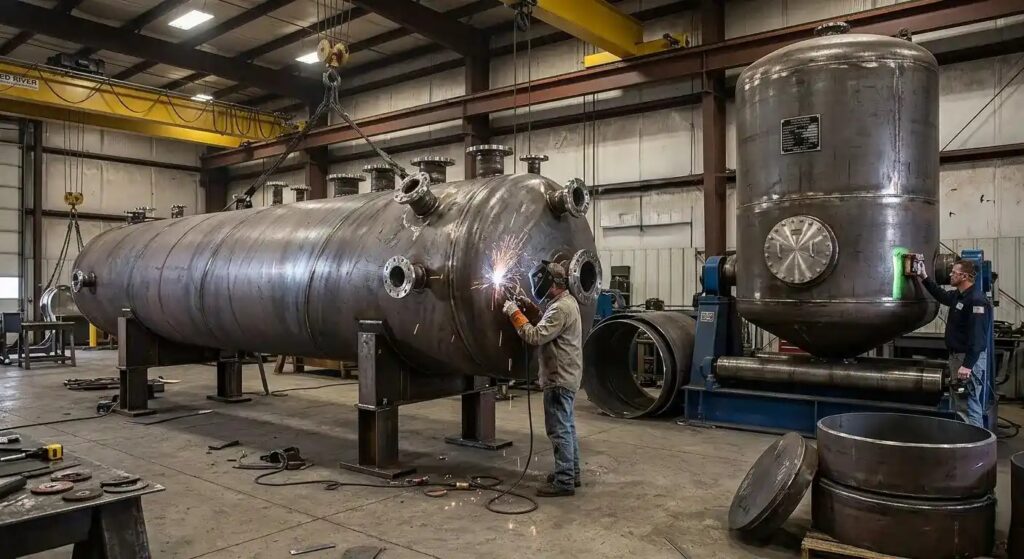
Pressurized storage vessels are closed containers engineered to hold gases or liquids at pressures above atmospheric, built to codes such as ASME Section VIII to contain that stored energy safely across their full service life. The vessel’s code division, material, and certification determine whether it performs as designed and clears every inspection it will face.
Key Takeaways
- Pressurized storage vessels are defined by the pressure boundary, not the contents. A closed vessel operating above 15 psig generally falls under ASME Section VIII construction rules.
- Type follows function. The main pressure vessel types are set by orientation, pressure rating, and the stored fluid, which decide whether the vessel is a horizontal receiver, a vertical column, or a thermal storage tank.
- Certification is verifiable. Confirm a fabricator’s active ASME U Stamp and National Board registration directly before awarding a contract.
- Material selection is a design decision, not a default. Carbon steel suits most service, while stainless and alloys are specified for corrosion, purity, or thermal cycling requirements.
- Documentation proves the build. Every coded vessel ships with an ASME Form U-1 data report, certified mill test reports, weld records, and NDE results as standard Red River delivery practice.
What Are Pressurized Storage Vessels and How Do They Work?
A pressurized storage vessel holds its contents above atmospheric pressure, which means the shell, the welds, and the connections form a pressure boundary that must contain stored energy without failing. That stored energy is what separates a pressure vessel from an ordinary atmospheric tank, and it is why pressurized vessel design is governed by code rather than left to the shop floor.
The Design Basis
Every coded vessel is designed around a maximum allowable working pressure (MAWP), the highest pressure the vessel may safely hold at its design temperature. Design pressure, design temperature, and corrosion allowance are set first, and wall thickness, head shape, and nozzle reinforcement follow from them. Red River’s pressure vessel fabrication scope confirms these design inputs with each client before fabrication begins.
The 15 psig Threshold
The practical threshold is 15 psig. A closed vessel that operates above that pressure generally falls under ASME Section VIII, which governs the materials, the joints, the examination, and the documentation. This applies whether the vessel stores compressed gas, a liquefied product, or a heated process fluid.
What Are the Main Types of Pressurized Storage Vessels?
Pressurized storage vessels are classified three ways: by orientation, by where they sit on the pressure-boundary line, and by the service they handle. Understanding these pressure vessel types helps a buyer specify the right vessel from the start.
By Orientation: Horizontal and Vertical
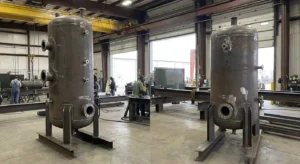
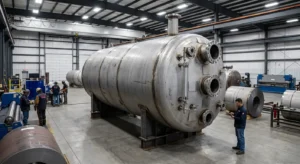
A horizontal vessel rests on saddle supports and spreads its footprint across the ground, which suits sites with floor area and lower overhead clearance. A vertical vessel stacks its volume upward on legs or a skirt, saving floor space but requiring overhead clearance for installation and maintenance access. Orientation also affects internal flow, separation, and nozzle positioning relative to surrounding equipment, so it is decided during design. Red River’s capabilities cover both orientations across all pressure vessel types.
By Pressure Boundary: Storage Tanks vs. Pressure Vessels
Not every storage container is a pressure vessel. Atmospheric and low-pressure tanks built to standards such as API 650 hold product at or near ambient pressure. Once the operating pressure rises above 15 psig, the container crosses into ASME Section VIII territory and becomes a coded pressure vessel with stricter material, joint, and testing requirements. The stored pressure, not the size or shape, decides which rules apply.
By Service: Gas, Liquid, and Process Fluids
The stored fluid drives much of the design. Compressed-gas receivers, liquefied-gas bullets, surge drums, separators, and heated process tanks are all pressure vessel types defined by their service, each carrying different temperature, corrosion, and cycling demands. A vessel for clean dry gas is designed very differently from one holding a corrosive or thermally cycled fluid, even at the same pressure. See Red River’s process tank scope for how service conditions shape vessel design.
What ASME Codes Govern Pressurized Storage Vessels?
The ASME Boiler and Pressure Vessel Code governs the construction of pressurized storage vessels through Section VIII. The code is organized into divisions that match the vessel’s pressure range and design approach.
Section VIII, Division 1
Division 1 covers the large majority of industrial pressure vessels using design-by-rule, a set of proven formulas and charts for wall thickness, head design, nozzle reinforcement, and joint efficiency. Most storage receivers, separators, and process vessels are built to Division 1, which balances rigor with practicality for everyday industrial pressures.
Section VIII, Division 2
Division 2 applies design-by-analysis with more detailed stress evaluation and tighter material and examination requirements. It allows thinner walls at higher pressures, which can pay off on large or high-pressure vessels where material savings justify the added engineering. The choice between divisions is set during design based on pressure, size, and economics.
The U Stamp and National Board Registration
A vessel built to Section VIII and certified by an authorized shop carries the ASME U Stamp. The National Board of Boiler and Pressure Vessel Inspectors maintains a permanent registration record for all stamped vessels. Together they prove the vessel was designed, built, and inspected to code. Red River holds active ASME U Stamp and NBBI R Stamp certifications, both verifiable directly with the issuing bodies.
What Materials Are Used to Fabricate Pressurized Storage Vessels?
Material selection for a pressurized storage vessel is a design decision driven by the stored fluid, the temperature, and the service life, not a default choice.
Carbon Steel for Standard Service
Carbon steel is the workhorse of pressure vessel construction. It offers good strength at a reasonable cost and suits most gas, water, and treated-fluid service where corrosion is controlled. Pressure-vessel-quality plate grades are specified to the code and traced from the mill through fabrication.
Stainless Steel and Alloys for Demanding Service
Stainless steel and higher alloys are specified when the stored fluid is corrosive, when purity requirements rule out carbon steel contact, or when aggressive thermal cycling would degrade a lesser material. These materials cost more, but for the right service they extend vessel life and protect product quality.
Material Traceability and Mill Test Reports
Every plate and fitting in a coded vessel carries a certified mill test report (MTR) documenting its chemistry and mechanical properties. This traceability is required for third-party inspection, insurance documentation, and regulatory audits, and it is part of how a vessel proves it was built from the materials its design specified.
How Are Pressurized Storage Vessels Designed?
Pressurized vessel design starts from the operating conditions and works outward to the geometry.
Pressure, Temperature, and Corrosion Allowance
Design pressure and design temperature set the structural demand, and the corrosion allowance adds material thickness to account for wall loss over the vessel’s life. These three inputs, confirmed before fabrication, drive wall thickness, head selection, and the choice of code division. Red River’s ASME pressure vessel fabrication process starts with confirming these inputs against the actual service conditions before any fabrication scope is defined.
Heads, Closures, and Joint Efficiency
The heads that close each end of a vessel carry pressure differently depending on their shape. Ellipsoidal and hemispherical heads handle pressure more efficiently than flat closures, so head selection affects both wall thickness and cost. Joint efficiency, set by how thoroughly the welds are examined, feeds directly into the wall-thickness calculation, which is why the examination plan and the design are decided together.
Nozzles, Supports, and Connections
Nozzles, manways, and supports are engineered into the pressure boundary, not added to it. Each opening weakens the shell and requires reinforcement, and each support transfers the vessel’s weight and external loads into its foundation. Nozzle orientation determines how the vessel connects to surrounding piping, so it is planned around the installed environment from the start.
How Are Pressurized Storage Vessels Fabricated and Tested?
ASME pressure vessel fabrication turns the design into steel through a controlled sequence of forming, welding, examination, and testing.
Forming, Welding, and Assembly
Plate is cut and rolled into shells, heads are formed, and nozzles and supports are fitted. The assembly is then welded by qualified welders following qualified procedures. Joint efficiency links welding quality back directly to the wall-thickness calculation, so both are specified together. Red River’s fabrication capabilities cover the full forming and assembly scope for both horizontal and vertical vessel configurations.
Nondestructive Examination and Hydrostatic Testing
Welds are examined by nondestructive examination methods, including radiographic, ultrasonic, magnetic particle, liquid penetrant, and visual testing, matched to the design pressure and joint efficiency class. The completed vessel is then hydrostatic tested at a minimum of 1.3 times the MAWP to confirm the structure holds. Red River coordinates and manages NDE examination and pressure testing through qualified inspection personnel, with documentation built as the vessel is fabricated. ASNT publishes guidance on examiner qualification applicable to all coded vessel work.
The Documentation Package
Every coded vessel ships with a complete documentation package: the ASME Form U-1 Manufacturer’s Data Report, certified MTRs, weld records, and NDE results. Building this package as the vessel is fabricated keeps closeout clean. See Red River’s prefabrication scope for how documentation is managed across modular vessel and skid packages.
What Safety and Inspection Requirements Apply?
Stored energy makes safety an engineering discipline across the full life of the vessel, not just at fabrication.
Pressure Relief Protection
Every pressurized vessel requires overpressure protection sized to its service. A relief valve or rupture disc set at or below the MAWP releases pressure before it exceeds what the vessel was designed to hold. The relief device is matched to the worst-case scenario, including blocked outlet or fire exposure, and is part of the system design from the start.
In-Service Inspection
Periodic inspection confirms a vessel in operation remains fit for service. Visual and thickness inspections track corrosion and wall loss against the corrosion allowance, and the interval depends on service severity and jurisdictional rules. Access provisions for inspection equipment are planned during the vessel siting phase, not after installation.
Repairs and Alterations Under the National Board
Repairs and alterations to a coded vessel are governed by the National Board Inspection Code (NBIC). A repair that affects the pressure boundary is re-examined and typically re-tested before the vessel returns to service. Red River’s capabilities cover R Stamp repair and alteration documented to the same standard as new construction.
Which Industries Rely on Pressurized Storage Vessels?
Pressurized storage vessels appear across nearly every heavy industry, each with its own pressure, temperature, and fluid demands that shape vessel design.
Oil and Gas
Upstream and midstream oil and gas operations use separators, surge drums, fuel-gas conditioning vessels, and storage receivers throughout the production chain. These vessels are frequently integrated into prefabricated skid packages that arrive on site pre-piped and ready to connect.
Power Generation and Thermal Storage
Power generation and combined heat and power plants use pressurized vessels for feedwater, condensate, and thermal energy storage. Many arrive as complete modular skid packages built under one quality system.
Biogas and Anaerobic Digestion
Biogas and anaerobic digestion processes are temperature-sensitive. Pressurized vessels hold heated process fluid within the operating window, and vessels for biogas service are specified with materials suited to the corrosive nature of the process environment.
Thermal Storage for Industrial and Commercial Applications
Chilled water and hot water thermal storage vessels are used across industrial and commercial cooling and heating applications, including campus plants and process facilities. Diffuser design and nozzle placement that support thermal stratification are confirmed in the specification before fabrication begins.
What Determines the Lead Time for a Pressurized Storage Vessel?
Lead time on a coded vessel is rarely set by the welding alone. Design, material procurement, fabrication, and testing each contribute, and the schedule is most predictable when the specification is complete before the project starts.
Design and Code Approval
A complete design specification shortens the front end. When design pressure, temperature, materials, and nozzle orientation are confirmed upfront, engineering and code calculations proceed without rework loops. Incomplete specifications force iteration between the client and the engineering team, adding weeks to the front end and compressing the fabrication window. The most reliable projects are the ones where the design basis is locked before any plate is ordered.
Material Procurement
Pressure-vessel-quality plate and specialty alloys carry their own lead times, and certified MTRs must travel with the material. Standard carbon steel grades are usually available quickly, while specialty stainless and alloy plates can extend procurement by several weeks. Procurement lead time is confirmed and documented in advance before the project schedule is committed, to avoid surprises during fabrication.
Fabrication and Testing
Forming, welding, examination, and pressure testing follow a controlled sequence. Skipping or compressing any step introduces risk to the documentation package and the quality record. Vessels delivered as part of a modular skid package add piping and assembly time but reduce field coordination requirements after delivery, often shortening the overall project schedule by compressing field installation scope. Red River’s modular skid packages and prefabrication services cover complete vessel-plus-skid scopes managed under one quality system.
How Do You Choose a Pressurized Storage Vessel Fabricator?
Choosing a custom pressure vessel manufacturer comes down to verifiable certification, documented examination capability, and real application experience.
Active ASME and National Board Certification
Verify the shop’s current U Stamp certificate number and National Board registration directly with the issuing bodies before awarding. Certification must be active at the time of fabrication.
Documented NDE and Pressure Testing Capability
A fabricator that relies on subcontractors for examination and testing introduces scheduling and quality risk. Documented NDE coordination and hydrostatic testing capability managed under one quality system protects both the schedule and the record.
Application Engineering Experience
General fabrication experience does not automatically include the application engineering a specific service requires, such as stratification design for thermal storage or material selection for corrosive fluids. A capable custom pressure vessel manufacturer engages on the service conditions early so the vessel is designed for its actual installation environment. Learn more at Red River’s about us page.
What This Means When Specifying Your Next Vessel
Pressurized storage vessels are only as reliable as the design, the materials, and the documentation behind them. The vessels that perform for decades and clear inspection cleanly are the ones whose code division, materials, and test plan were confirmed in the specification before the first plate was cut. The fabricators that deliver those results are the ones who treat design inputs, documentation, and examination as part of the build rather than checkboxes at the end.
Work With Red River on Your Pressurized Storage Vessel
Red River has fabricated ASME-certified pressurized storage vessels for oil and gas, power generation, biogas, and industrial process applications from Gillette, Wyoming, since 2003. Red River holds active ASME U Stamp and NBBI R Stamp certifications and is an American Welding Society (AWS) member.
Ready to Discuss Your Vessel Requirements?
Request a quote or call 1-307-257-5332 to discuss your vessel’s service conditions, code requirements, and fabrication scope with Red River’s team.
Frequently Asked Questions
1. What Is the Difference Between a Storage Tank and a Pressurized Storage Vessel?
A storage tank holds product at or near atmospheric pressure and is built to tank standards such as API 650. A pressurized storage vessel operates above 15 psig and is built to ASME Section VIII, with stricter material, joint, and testing requirements. The operating pressure, not the size or shape, decides which rules apply.
2. What Pressure Makes a Vessel an ASME Pressure Vessel?
A closed vessel that operates above 15 psig internal pressure generally falls under ASME Section VIII construction rules. Below that threshold, other tank standards typically apply. The design specification confirms the operating and design pressures that place a vessel under the code.
3. How Long Do Pressurized Storage Vessels Last?
With correct material selection, appropriate corrosion allowance, and periodic inspection, a coded pressure vessel can serve for decades. Service life depends on the fluid, the operating conditions, and the inspection and maintenance program. The corrosion allowance built into the design accounts for expected wall loss over that life.
4. Can Pressurized Storage Vessels Be Delivered as a Modular Skid Package?
Yes. A modular skid package integrates the vessel with piping, instrumentation, and structural support into a single pre-tested assembly. All components are tested and documented together before the skid ships, which reduces field installation time and construction schedule risk.
5. How Do I Verify a Fabricator’s ASME Certification?
Confirm the shop’s current U Stamp certificate number directly with ASME and check National Board registration for stamped vessels. Certification must be active at the time of fabrication. A reputable fabricator provides its certificate numbers on request.
6. Does Red River Fabricate Custom Pressurized Storage Vessels?
Yes. Red River builds ASME-certified pressurized storage vessels designed to each client’s service conditions, including material selection, nozzle orientation, and support configuration for the actual installation environment. Design details are confirmed during the engineering review before fabrication begins.
Related Blog Post
Which Materials Suit Make-Up Water Service?
How Big Should Make-Up Water Tanks Be?
Make-Up Water Tanks: Design, Sizing, and Fabrication
When to Spec Equalization Tanks for Industrial Systems
How Do Equalization Tanks Balance Flow?
About Author