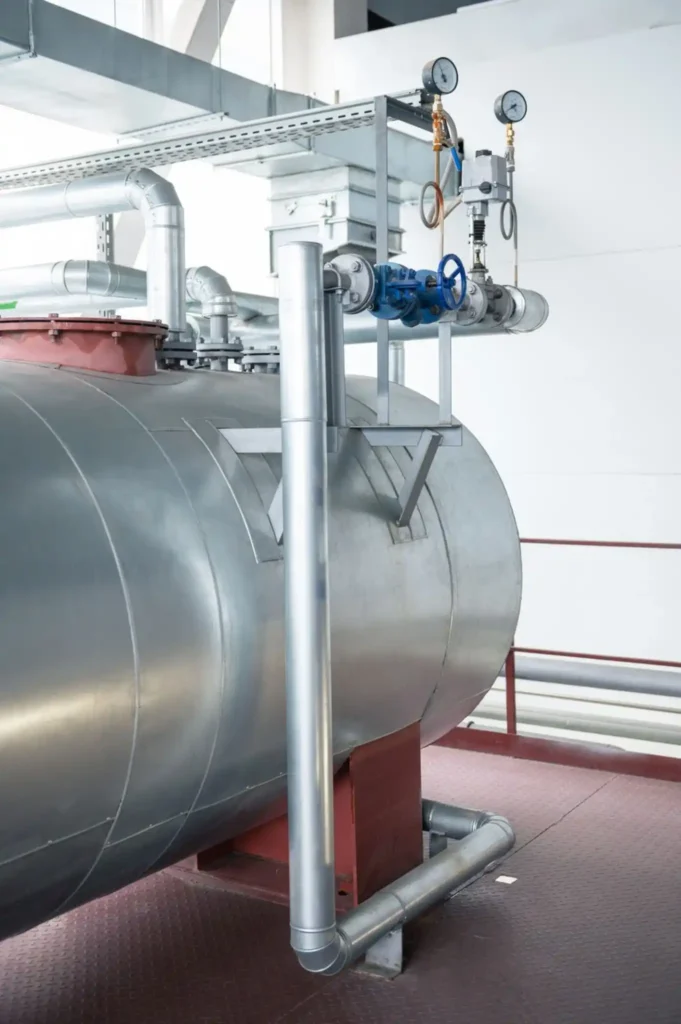
Deaerator tanks remove dissolved oxygen and other non-condensable gases from boiler feedwater before it enters the boiler, reducing dissolved oxygen content to below 0.005 cc per liter. A feedwater system without effective boiler feedwater deaeration corrodes from the inside, costing facilities far more in tube replacements, chemical treatment, and unplanned shutdowns than the cost of a correctly specified deaerator.
Key Takeaways
- Deaerator tanks physically remove dissolved oxygen and carbon dioxide from boiler feedwater through heat and mechanical agitation, reducing oxygen content to below 0.005 cc per liter.
- Two primary designs are used in industrial applications: tray-type deaerators, which cascade water across trays for maximum contact with steam, and spray-type deaerators, which atomize feedwater through nozzles into a steam atmosphere.
- ASME Section VIII Division 1 applies to ASME pressure vessel steam system components operating above 15 psig. Both the deaeration column and the storage vessel must carry the U Stamp.
- Deaerator sizing is driven by boiler evaporation rate, feedwater temperature, system pressure, and required storage capacity for startup and load swings.
- Modular skid-mounted deaerator packages integrate the deaeration column, storage tank, feedwater pumps, level controls, and instrumentation into a single pre-tested assembly, reducing field installation time and commissioning risk.
What Are Deaerator Tanks and How Do They Work?
A deaerator tank is a pressure vessel used in steam generation systems to remove dissolved oxygen and free carbon dioxide from boiler feedwater. Both gases accelerate corrosion in boiler tubes, steam drums, and condensate return lines. Oxygen pitting is one of the most destructive failure modes in steam systems, capable of reducing tube wall thickness to the point of failure within years of service without adequate deaeration.
The Two Physical Principles Behind Deaeration
The deaeration process works on two physical principles. First, the solubility of gases in water decreases as water temperature increases. Heating feedwater to saturation temperature at the deaerator operating pressure drives dissolved gases out of solution. Second, mechanical agitation through spray nozzles or tray cascades increases the surface area of the water exposed to the steam atmosphere, accelerating gas release and venting.
What Happens After Deaeration
After deaeration, treated feedwater collects in the storage section of the vessel, where it is held at saturation temperature until drawn into the boiler feed pump suction. The storage volume provides a buffer for load swings and system startup events that would otherwise pull cold, oxygenated water into the boiler feed pump. Red River’s pressure vessel fabrication scope covers deaerator storage vessels for power generation, oil and gas, and process industry applications.
What Is the Difference Between Tray-Type and Spray-Type Deaerators?
The two principal deaerator tank fabrication designs handle gas removal differently. Each has application strengths that make it the better choice for specific system configurations.
Tray-Type Deaerators
In a tray-type deaerator, feedwater enters at the top of the deaeration column and cascades over a series of stainless steel trays. Steam enters from below and flows countercurrently upward through the falling water, maximizing contact surface area and driving dissolved gas out of solution efficiently.
Tray-type deaerators are preferred for large power generation facilities and industrial steam systems with high and consistent feedwater flow rates. They perform well across a wide operating range and tolerate variations in inlet water temperature better than spray-only designs. The trays require periodic inspection and replacement as stainless steel components in a wet steam environment.
Spray-Type Deaerators
In a spray-type deaerator, feedwater enters through spring-loaded spray valves that atomize the water into fine droplets and disperse it into the steam space of the deaeration column. The large surface area created by the spray promotes rapid heating and gas release. A scrubbing steam flow then carries the released gases to the vent.
Spray-type designs are simpler mechanically and have no internal tray components to inspect or replace. They are commonly used in smaller industrial systems, packaged boiler installations, and applications where maintenance access to the deaeration column interior is limited. Performance is more sensitive to inlet water temperature variations than tray-type units.
Combined Tray and Spray Designs
Many modern industrial deaerators use a combined design: spray nozzles provide initial heating and partial deaeration at the inlet, and a tray section below provides final gas removal before the feedwater enters the storage vessel. This arrangement delivers the mechanical simplicity of spray deaeration at the inlet with the high efficiency of tray deaeration for final treatment.
What ASME Certification Requirements Apply to Deaerator Tanks?
Deaerator storage vessels operating above 15 psig must carry the ASME U Stamp under Section VIII Division 1. The deaeration column, which operates at similar or higher pressures, is also subject to coded vessel requirements. Both sections must be designed, fabricated, and inspected under a certified quality program.
What ASME Code Governs on Deaerator Pressure Components
ASME code governs material selection, nozzle design and reinforcement, hydrostatic testing at 1.3 times the MAWP, and NDE requirements matched to joint efficiency classification and design pressure. Carbon steel is standard for most deaerator storage vessels. Internal trays are typically 304 or 316 stainless steel, specified for corrosion resistance in the wet steam environment.
National Board Registration and Documentation
The National Board of Boiler and Pressure Vessel Inspectors maintains permanent registration records for all stamped vessels. Red River holds both the ASME U Stamp and the NBBI R Stamp. Red River coordinates and manages NDE examination through qualified inspection personnel, and every vessel ships with a complete documentation package: ASME Form U-1, certified mill test reports, weld records, NDE reports, and the hydrostatic test record. See Red River’s fabrication capabilities for the full certification and quality program scope.
The DOE Position on Boiler Feedwater Conditioning
The U.S. Department of Energy identifies proper feedwater conditioning, including deaeration, as a critical factor in boiler system efficiency and longevity. Facilities that operate boilers without effective deaeration face higher chemical treatment costs and significantly shorter boiler component service life.
How Is a Deaerator Tank Sized?
Sizing a deaerator tank requires defining two independent parameters: deaeration capacity (the rate at which feedwater must be processed) and storage volume (the reserve required to handle startup conditions and load swings).
Deaeration Capacity
Deaeration capacity is measured in pounds per hour (lb/hr) or gallons per minute (GPM) of feedwater processed. The required capacity equals the maximum boiler evaporation rate plus any makeup water entering the system. For systems with multiple boilers, the deaerator must be sized for the combined feedwater demand at maximum load.
Inlet water temperature affects capacity significantly. Cold makeup water requires more steam to reach saturation temperature than warm condensate return. Systems with high makeup water ratios, such as oil and gas steam flooding applications, need larger deaerator columns to handle the additional heating load.
Storage Volume
Standard industry practice is to provide a minimum of ten minutes of feedwater storage at the maximum boiler evaporation rate. Many power generation and industrial facilities specify fifteen to twenty minutes of storage to accommodate load swings, pump changeovers, and cold startup events where large volumes of makeup water enter the system simultaneously.
Storage volume is the primary driver of the physical size of the deaerator storage vessel. A system processing 50,000 lb/hr of feedwater at twenty minutes of storage requires approximately 1,650 gallons of net storage volume in the deaerator vessel.
Operating Pressure
Deaerators operate at pressures between 5 psig and 50 psig in most industrial applications, with the most common range being 5 to 15 psig. Higher operating pressure raises the saturation temperature of the water, which improves deaeration efficiency and reduces dissolved oxygen content. Pressure selection must be coordinated with the boiler feed pump design to ensure adequate net positive suction head (NPSH) at the pump inlet.
Which Industries Use Deaerator Tanks?
Deaerator tanks are used across power generation, oil and gas, biogas, and industrial process steam applications. Each places different demands on vessel size, operating pressure, and materials.
Power Generation
Power generation facilities operate deaerators continuously at the heart of the steam-water cycle, receiving a combination of condensate return and cold makeup water. Operating pressure is typically set to recover heat from low-pressure extraction steam from the turbine, improving overall cycle efficiency.
Oil and Gas Steam Flooding
Steam-assisted gravity drainage (SAGD) and steam flooding operations use deaerators to protect the once-through steam generators (OTSGs) that generate the injection steam. These systems operate with very high makeup water fractions because there is no condensate return from the reservoir. Deaerators in SAGD service are frequently integrated into modular skid assemblies that arrive at the pad site pre-assembled and pre-tested.
Biogas and Biomethane Facilities
Biogas processing facilities that use steam for gas conditioning and heating require feedwater protection equivalent to any other steam system. Deaerators in biogas service are typically smaller than power generation units but must handle the corrosion challenges of a facility environment where hydrogen sulfide and carbon dioxide are present in the process gas stream.
Industrial Process Steam
Chemical plants, refineries, food processing facilities, and pharmaceutical manufacturers that use steam for process heating all require feedwater protection. Vessel sizing in these applications is driven by steam demand variability. Facilities with batch processes and intermittent steam loads need more storage volume relative to deaeration capacity than continuous process facilities. See Red River’s process tank fabrication scope for related vessel types.
What Are Modular Skid-Mounted Deaerator Packages?
A deaerator skid package integrates the column, storage vessel, feedwater pump set, level controls, pressure controls, instrumentation, and structural support frame into a single pre-tested assembly. All components are tested and documented before the skid leaves the fabrication facility.
Why the Modular Approach Fits Deaerator Applications
For remote sites, SAGD pad installations, and industrial facilities with constrained construction schedules, a factory-assembled deaerator package eliminates field assembly errors, reduces installation labor, and compresses the commissioning timeline. Red River’s prefabrication services cover complete pre-tested deaerator and steam system assemblies for power generation, oil and gas, and biogas applications.
What to Confirm Before Awarding a Deaerator Fabrication Contract
Active ASME U Stamp Certification
Verify the fabricator’s current U Stamp certificate is active at the time of fabrication. Both the storage vessel and deaeration column must be fabricated under a certified quality program. Certification must be confirmed directly, not assumed from a prior project reference.
Experience With Deaerator Vessels Specifically
Confirm the fabricator understands the internal tray arrangement, nozzle placement for feedwater inlet and steam distribution, vent sizing, and the corrosion allowance requirements for wet steam service. General pressure vessel fabrication experience does not automatically include knowledge of deaerator-specific design requirements.
NDE and Pressure Testing Scope
Confirm how NDE and hydrostatic testing are managed and documented across the build scope. Understanding how inspection is coordinated helps confirm the full quality program stays under one project team’s control.
Full Documentation Package on Delivery
Confirm the fabricator will deliver ASME Form U-1, certified mill test reports, weld records, NDE reports, hydrostatic test records, and the as-built drawing package. Missing documentation delays National Board registration and jurisdictional inspection approval.
Deaerator Tanks Built for Your Steam System
Deaerator tanks operate continuously at the most critical point in any steam system. The vessel quality, weld integrity, and documentation behind each unit determine whether the boiler system runs reliably for decades or faces recurring corrosion failures. Red River fabricates ASME-certified deaerator storage vessels and complete skid packages for power generation, oil and gas, biogas, and industrial process steam applications from Gillette, Wyoming, since 2003. Every vessel is built to the system’s exact operating parameters, tested to code, and delivered with full National Board documentation.
Discuss Your Deaerator Tank Requirements With Red River
Request a quote or call 1-307-257-5332 to discuss deaerator tank design, ASME certification, sizing, and fabrication scope with Red River’s team. The specification review starts before any plate is cut.
Frequently Asked Questions
1. What Dissolved Oxygen Level Does a Deaerator Tank Achieve?
A properly operating deaerator reduces dissolved oxygen in boiler feedwater to below 0.005 cc per liter (approximately 7 parts per billion by weight). This level is below the threshold at which oxygen pitting corrosion becomes a significant risk in carbon steel boiler tubes and condensate return piping. Actual performance depends on operating pressure, inlet water temperature, steam flow rate, and the condition of the internal deaeration components.
2. What Is the Difference Between a Tray Deaerator and a Spray Deaerator?
A tray deaerator cascades feedwater over stainless steel trays while steam flows countercurrently upward, maximizing contact between water and steam for efficient gas removal. A spray deaerator atomizes feedwater through nozzles into the steam space, creating high surface area through droplet formation. Tray designs are preferred for large, continuous-load systems; spray designs are simpler mechanically and better suited to smaller or more variable-load applications.
3. How Long Should a Deaerator Storage Vessel Provide Feedwater?
The minimum industry standard is ten minutes of feedwater storage at the maximum boiler evaporation rate. Many facilities specify fifteen to twenty minutes to accommodate load swings, pump changeovers, and startup conditions. Facilities with high makeup water fractions or batch process steam loads typically require the upper end of that range.
4. Does a Deaerator Tank Need to Be ASME Certified?
Yes. Any deaerator storage vessel or deaeration column operating above 15 psig must carry the ASME U Stamp under Section VIII Division 1. Operation of a non-coded pressure vessel in this service is a code violation that affects insurance coverage, jurisdictional registration eligibility, and plant safety compliance.
5. Can Deaerator Tanks Be Integrated Into Modular Skid Packages?
Yes. Deaerator skid packages that integrate the deaeration column, storage vessel, feedwater pumps, level controls, instrumentation, and structural frame are widely used in oil and gas, power generation, and biogas applications. Factory assembly and testing of the complete package reduces field installation time, eliminates multi-vendor coordination, and provides a single documentation trail for the entire feedwater system.
Related Blog Post
Can Condensate Storage Improve Reliability?
Where Do Condensate Tanks Fit in a Steam System?
Which Nozzles Simplify Maintenance on Pressure Vessels?
How to Vent Condensate Tanks in Steam Systems
How Do Baffle Layouts Affect Stratification in TES Tanks?
About Author