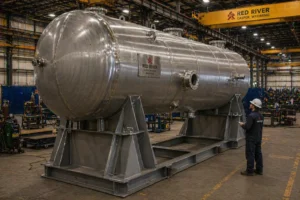
Thermal Storage Tanks for Industrial Use

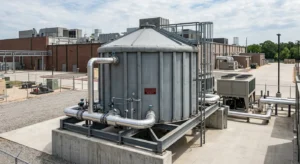
A thermal storage tank for industrial use stores thermal energy as temperature-controlled fluid, typically chilled water, hot water, or process fluid, and releases it on demand. This decouples when thermal energy is generated from when it is needed, so a facility can generate during low-cost off-peak periods and draw stored capacity during peak rate windows. For large facilities on demand-based utility tariffs, that shift is one of the more reliable ways to cut annual energy cost without compromising process performance.
Read More »
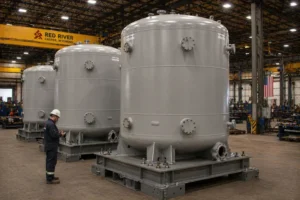
thermal storage tanks for data centers fabricated by Red River

Thermal Storage Tanks for Data Centers

Thermal storage tanks for data centers are engineered vessels, not commodity storage, and a wrong specification creates cost and resilience problems that compound over the facility’s life. This guide covers what procurement managers and project engineers need to know before the RFQ goes out. Why Thermal Storage Tanks for Data Centers Are Critical Infrastructure A data center without thermal storage is entirely dependent on its chiller plant running at full capacity whenever cooling demand peaks. That creates two problems that

Read More »
when are shake table tests required pressure vessel seismic qualification Red River

When Are Shake Table Tests Required for Industrial Equipment

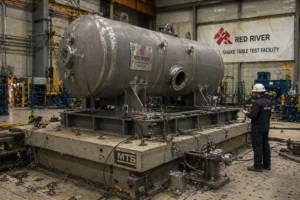
Shake table tests are required when applicable standards, regulatory authorities, or project specifications demand physical seismic qualification rather than analysis alone. This guide covers which standards drive those requirements and what they mean for equipment design and fabrication. What Shake Table Testing Actually Is A shake table test subjects a piece of equipment to simulated seismic motion to demonstrate it can survive and remain functional through a defined ground motion event. The equipment is mounted on a platform that replicates

Read More »
seismic zones impact vessel supports pressure vessel fabrication Red River Wyoming

How Do Seismic Zones Impact Vessel Supports

Seismic zone classification is not a checkbox on a design form. This guide covers how seismic zones impact vessel supports, which code requirements drive fabrication scope, and what fabricators need before cutting steel. What Seismic Zone Classification Actually Determines Seismic hazard in the United States is mapped and categorized through the International Building Code (IBC) and ASCE 7, which assigns structures to Seismic Design Categories (SDC) A through F based on the site’s mapped spectral acceleration values and the occupancy

Read More »
anchorage details pass review pressure vessel fabrication Red River Wyoming

What Anchorage Details Pass Review?

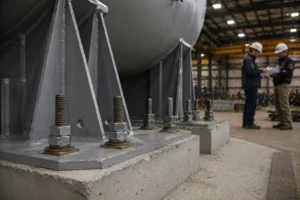
Anchorage details are one of the most commonly flagged items during pressure vessel and storage tank installation reviews. This guide covers what inspectors look for, what causes submittals to get rejected, and how to structure anchorage documentation that passes the first time. Why Anchorage Review Is a Separate Discipline from Vessel Fabrication Vessel fabrication and anchorage design are governed by different codes and carried out by different disciplines, but they have to work together precisely. The fabricator is responsible for

Read More »
seismic rated storage tanks fabrication Red River Wyoming

Seismic Rated Storage Tanks: Design & Fabrication Guide

Seismic rated storage tanks are required in any seismically active region where local codes mandate earthquake design. This guide covers what seismic rating means, which codes apply, how requirements change the fabrication scope, and what to ask a fabricator before issuing a purchase order. What Seismic Rating Means for a Storage Tank Seismic rating is not a sticker on the side of a vessel. It is a design classification that defines how a tank is engineered to respond to earthquake-induced

Read More »