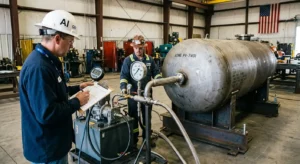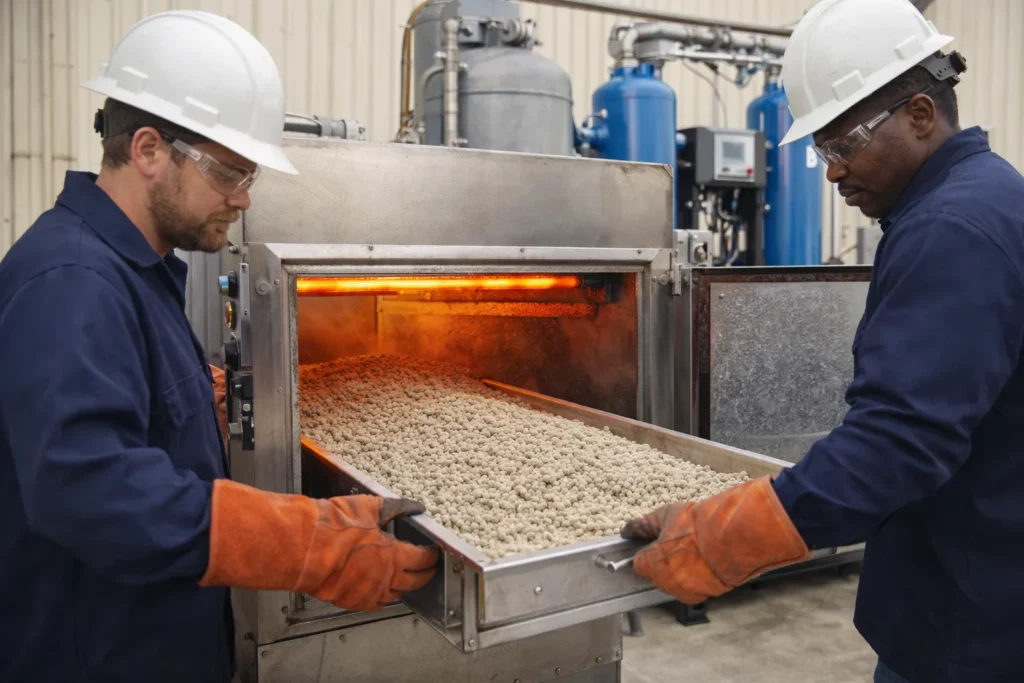
Desiccants can often be rejuvenated to restore their moisture-absorbing ability, reducing replacement costs and supporting sustainable operations. Proper rejuvenation extends desiccant life and maintains effective moisture control across industrial applications.
Understanding Rejuvenate Desiccant for Moisture Control
Desiccants can often be rejuvenated to restore their moisture-absorbing ability, reducing replacement costs and supporting sustainable operations. Proper rejuvenation extends desiccant life and maintains effective moisture control across industrial applications, especially in systems involving pressure vessels, compressed air, and process equipment.
At Red River, we pride ourselves on being more than a pressure vessel manufacturer. We provide engineered solutions across oil and gas, public works, power generation, minerals, and biogas sectors. Learn more about our full capabilities on our home page or explore our expertise in pressure vessels, prefabrication, and modular skids.
What Are Desiccants?
Desiccants are materials designed to remove moisture from air, gas, or enclosed environments through adsorption. By maintaining low humidity levels, they protect equipment, products, and infrastructure from water damage.
In industrial settings, desiccants are commonly used in adsorption dryers, air receiver systems, and sealed pressure vessels. If you want deeper insight into drying systems, see our guide on desiccant dryers in industrial applications.
Moisture control is especially critical in pressurized environments because trapped water can accelerate corrosion, reduce efficiency, and create safety risks. Our article on water presence in pressure vessels explains these challenges in detail.
Common Types of Desiccants
Different desiccant materials are engineered for specific operating conditions.
Silica Gel
Widely used for packaging, electronics protection, and moderate humidity control.
Activated Alumina
Ideal for compressed air drying and gas processing due to high mechanical strength.
Molecular Sieves
Highly effective for deep drying applications requiring extremely low dew points.
For a comprehensive overview, visit our types of desiccant materials guide and our resource on molecular sieves. You can also learn activation techniques in our article on activating molecular sieves.
Applications of Desiccants in Industry
Desiccants protect equipment across many sectors:
Compressed air systems
Natural gas processing
Chemical manufacturing
Pharmaceutical production
Food preservation
Electronics protection
They are particularly important in adsorption air dryers and pressure vessels where moisture can cause internal corrosion or contamination. Explore related technologies in our article on adsorption air dryers and the role of air receiver tanks.
In separation systems, moisture removal also supports efficient phase separation. Learn more in our guide to separator technology and 2-phase vertical separators.
Importance of Desiccants in Moisture Control
Effective moisture control preserves system reliability and safety. Without it, equipment may suffer:
Corrosion and structural weakening
Microbial growth
Reduced insulation performance
Product degradation
Increased maintenance costs
For pressure equipment, moisture control directly affects service life and compliance. See our insights on pressure vessel safety and compliance and inspection practices.
Why Rejuvenate Desiccant?
Benefits of Rejuvenation
Rejuvenation restores adsorption capacity by removing trapped moisture from the desiccant structure. This helps maintain performance without full replacement.
It is particularly valuable in large industrial dryers and vessels where shutdowns are costly. For system sizing considerations, review our guide on how to size a desiccant dryer.
Cost Savings
Replacing desiccant beds can be expensive due to material costs, labor, and downtime. Rejuvenation significantly reduces these expenses while maintaining operational efficiency.
Environmental Impact
Reusing desiccant minimizes waste generation and supports sustainable industrial practices. It also reduces demand for new raw materials and transportation emissions.
Can You Rejuvenate Desiccant?
Yes. Most industrial desiccants can be rejuvenated using controlled heating or purge processes that drive off absorbed moisture.
However, effectiveness depends on contamination levels and physical degradation. If oils or chemicals foul the material, replacement may be necessary.
For molecular sieve maintenance techniques, see our detailed guide on how to dry molecular sieve.
Rejuvenation vs Replacement
When Rejuvenation Is Ideal
Desiccant is moisture-saturated but uncontaminated
Structural integrity remains intact
System downtime must be minimized
Cost savings are a priority
When Replacement Is Necessary
Chemical contamination
Dusting or physical breakdown
Reduced adsorption capacity after regeneration
Safety or compliance concerns
Understanding system design helps determine the best option. Our overview of pressure vessel definitions and thresholds provides useful context for regulated equipment.
Feasibility by Desiccant Type
Different materials respond differently to regeneration:
Silica Gel: Easily regenerated at moderate temperatures
Activated Alumina: Durable and suitable for repeated cycles
Molecular Sieves: Require higher temperatures but deliver superior drying
Performance also depends on system configuration, airflow, and operating pressure. Learn more about industrial vessel types in our article on types of industrial pressure vessels and compressed air tanks.
Effectiveness of Rejuvenated Desiccant
When performed correctly, rejuvenation can restore most of the original adsorption capacity. Industrial twin-tower dryers routinely rely on cyclic regeneration to provide continuous dry air.
Maintaining effectiveness requires:
Proper temperature control
Adequate purge flow
Clean inlet air
Regular inspection
Failure to manage moisture can contribute to vessel degradation or failure modes. For more information, see our resources on pressure vessel failure types and failure criteria.
Need a reliable partner?
Red River specializes in the design and manufacturing of pressure vessels. We also fabricate related items such as prefabricated spools and skid packages.
Reach Out to us today and experience the Red River difference. Where American Made and American Values come together, we care more.
Frequently Asked Questions
1. Can All Desiccants Be Rejuvenated?
Not all desiccants are suitable for rejuvenation. The feasibility depends on the type and condition of the desiccant. For example, silica gel and activated alumina are commonly rejuvenated, but some specialized desiccants may have different requirements or may not be suitable for rejuvenation at all.
2. How Long Does the Rejuvenation Process Take?
The time required to rejuvenate desiccants can vary based on the method used and the quantity of desiccant. For instance, oven rejuvenation might take several hours, while microwave methods can be faster but are limited to smaller quantities.
3. What Equipment Do I Need to Rejuvenate Desiccant?
The equipment needed depends on the rejuvenation method. For heating, you’ll need an oven or microwave. For using a dehumidifier, you’ll need a dehumidifying setup. Safety equipment like gloves and goggles is also essential to protect yourself during the process.
4. How Can I Tell If My Desiccant Needs Rejuvenation?
Desiccants that need rejuvenation may show signs such as discoloration, clumping, or reduced moisture absorption. Monitoring the performance of your desiccant regularly can help you determine when it’s time for rejuvenation.
5. Can Rejuvenated Desiccant Be Used in All Applications?
Rejuvenated desiccants can generally be used in most applications where fresh desiccants are used. However, it’s crucial to ensure that the rejuvenation process has been thorough and that the desiccant is free from any contaminants or damage.
Key Takeaways
- Many desiccants such as silica gel and activated alumina can be rejuvenated through controlled heating or other methods.
- Rejuvenation helps reduce operational costs and environmental waste by extending desiccant lifespan.
- Not all desiccants are suitable for rejuvenation, and effectiveness depends on type and condition.
- Signs that rejuvenation is needed include discoloration, clumping, and reduced moisture-absorption performance.
Related Blog Post
Condensate Tanks: Types, Fabrication, and ASME Code
Which Tests Validate Deaeration in Pressure Systems?
Equalization Tanks: Design, Sizing, and Fabrication
What Are Thermal Storage Testing Standards for TES Vessels?