
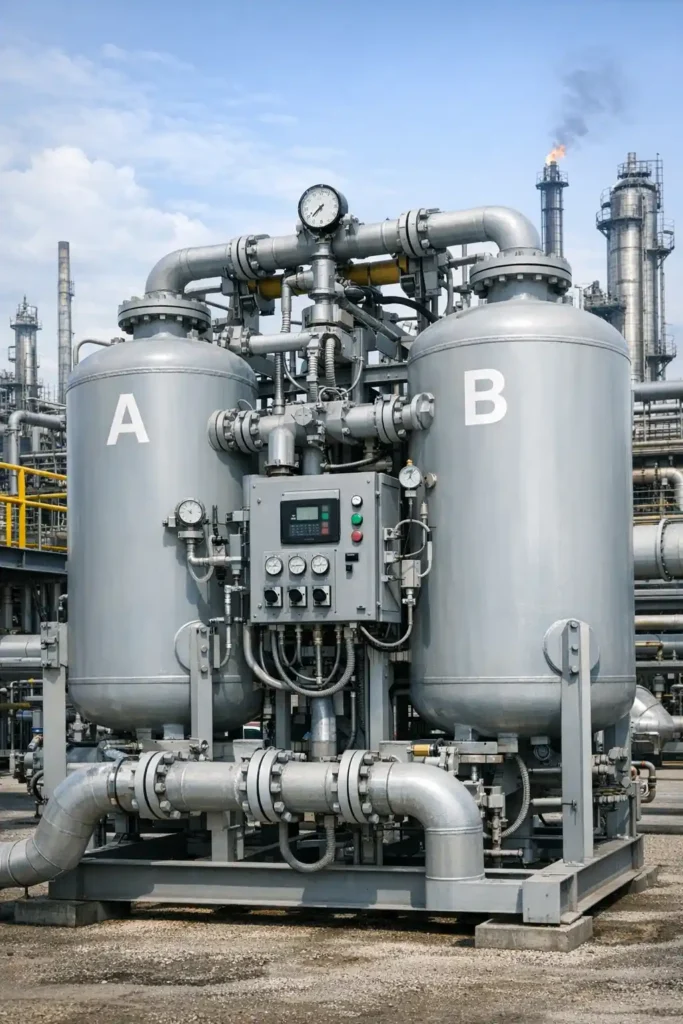
Silica gel works but isn’t always the best option for industrial moisture control. This guide compares silica gel to superior alternatives like molecular sieves, activated charcoal, bentonite clay, and advanced desiccant packs. You’ll learn which desiccant performs best in different conditions, how to choose the right one, and why Red River’s solutions go beyond basic moisture protection.
Understanding Silica Gel and Its Uses
Silica gel has long been the go-to solution for controlling moisture across various industries, from electronics to pharmaceuticals. But as industrial needs evolve, many are asking: What are the best alternatives to this desiccant? At Red River, we engineer and fabricate the pressure vessels, desiccant dryer vessels, and modular process skids that house these moisture control systems built to ASME standards for Oil & Gas, Power Generation, and Bio Gas applications.”
What is Silica Gel?
Silica gel is a porous, granular form of silicon dioxide made synthetically from sodium silicate. It’s most commonly used as a desiccant to control humidity and prevent spoilage or degradation of products. You’ve likely seen it in small packets tucked inside everything from shoeboxes to electronic devices, working silently to soak up moisture.To understand how desiccants are regenerated and when to replace them, see how desiccants are regenerated.
Common Applications of Silica Gel in Industrial Settings
In commercial settings, this material is widely utilized. It’s regularly deployed in packaging to protect products during transit, in air dryers to keep pneumatic systems functioning properly, and in electrical enclosures to prevent corrosion and short circuits. Its versatility has made it a staple across industries ranging from pharmaceuticals to electronics. To understand related industrial applications, see understanding molecular sieves and desiccants and pressure-drop in desiccant dryers.
Limitations of Silica Gel as a Moisture Absorber
While effective, silica gel has limitations, especially compared to modern desiccants. It absorbs a finite amount of moisture before becoming saturated and losing effectiveness. In high-humidity environments or where long-term moisture control is critical, silica gel may not be the most reliable option. Additionally, its regeneration process (heating to remove moisture) can be cumbersome and energy-intensive. Learn more about how to dry desiccant.
Top Alternatives to Silica Gel for Moisture Control
Choosing the right desiccant for your process starts with understanding what each material does and where it falls short. The four most common desiccant alternatives each suit different industrial environments, and the wrong choice can mean premature saturation, unplanned maintenance, or compromised product quality.
Desiccant Packs: A Superior Option for Industrial Applications
Desiccant packs are often filled with advanced materials like calcium chloride or molecular sieve blends. Compared to silica gel, they:
- Absorb up to 4x more moisture by weight
- Last longer in high-humidity environments
- Require less frequent replacement or regeneration
Ideal for long-haul transit, sealed enclosures, and fluctuating temperatures. For detailed guidance, see ultimate guide to sizing a desiccant dryer and essential guide to desiccant air dryer maintenance.
| Desiccant Type | Absorption Rate | Regeneration Needed | Eco-Friendly? |
| Silica Gel | Moderate | Yes (heat required) | Partially |
| Molecular Sieves | High | Yes (more efficient) | Limited |
| Activated Charcoal | Moderate (plus odor control) | Yes | Yes |
| Bentonite Clay | Low–moderate | No (disposable) | ✅ Yes |
Performance benchmarks vary by application and operating condition — for standardized desiccant performance data, refer to ASHRAE desiccant performance guidelines.
Activated Charcoal: A Natural and Effective Alternative
Activated charcoal is a natural alternative to silica gel. Its porous structure allows it to absorb not only moisture but also odors and impurities, making it versatile for industries requiring stringent environmental controls. Related insights can be found in understanding molecular sieves and their role in solvent drying.
Molecular Sieves: High-Efficiency Moisture Absorption
Molecular sieves absorb moisture at a molecular level, offering unmatched performance. They are especially useful in high-temperature or ultra-dry conditions. Explore more in how to choose the right molecular sieve for your application and understanding molecular sieve lifespan.
Bentonite Clay: An Eco-Friendly Silica Gel Substitute
Bentonite clay provides strong moisture control while remaining eco-friendly, making it ideal for industries prioritizing sustainability without compromising performance. Learn more about eco-friendly options in When Should You Use a Desiccant Dehumidifier. Bentonite clay is recognized under the EPA’s Safer Choice classification as a low-hazard material, making it a practical choice for operations with strict environmental or disposal requirements.
Choosing the Right Moisture Absorber for Your Needs
Selecting the best desiccant depends on your operating environment and moisture control goals:
- High-humidity environments benefit from molecular sieves due to better saturation resistance
- Eco-sensitive applications favor bentonite clay for safe moisture protection
- Odor-sensitive packaging requires activated charcoal for dual moisture and odor control
Factors to Consider When Upgrading Your Desiccant
Evaluate your specific needs, including humidity levels, temperature range, and the operational environment. Consider durability and replacement frequency to ensure optimal performance. See the ultimate guide to replacing an expansion vessel yourself and understanding the lifespan of scrubbers for maintenance insights.
Cost-Effectiveness and Efficiency Comparison
While some alternatives have a higher upfront cost, their longer lifespan and higher efficiency can lead to cost savings over time. Compare options like molecular sieves or activated charcoal for both efficiency and budget alignment.
Why Red River’s Solutions are the Best Choice
Red River fabricates the vessels and process skids that house your moisture control systems, not the desiccants themselves. That distinction matters. Our ASME U-Stamp certified pressure vessels and desiccant dryer vessels are built to hold up under the operating conditions that desiccants like molecular sieves and activated charcoal demand: high temperatures, pressure cycling, and continuous regeneration loads.
We work with clients in Oil & Gas, Power Generation, Bio Gas, and Minerals to spec and fabricate the right vessel for the desiccant system their process requires. If you’re designing or upgrading a desiccant drying system, that conversation starts with the vessel, and that’s where Red River comes in.
Ready to elevate your moisture control?
Red River fabricates ASME-certified pressure vessels, desiccant dryer vessels, and modular process skids built to handle demanding moisture control environments. If you’re specifying or upgrading a desiccant drying system, contact our team to discuss vessel design, materials, and fabrication requirements for your application.”
Frequently Asked Questions
1. What’s the main difference between silica gel and molecular sieves?
Silica gel absorbs moisture across a broad humidity range but saturates quickly and loses effectiveness in high-heat environments. Molecular sieves use a structured pore size to trap water with greater precision, making them the better choice for process drying applications like natural gas dehydration, where extremely low moisture levels are required.
2. How do I choose the right desiccant for my industrial application?
Match the desiccant to your operating conditions temperature range, humidity levels, and moisture target. Loose tolerances allow for lower-cost options like silica gel or bentonite clay; tight specs (sub-50 ppm) point to molecular sieves. Red River can help identify the right vessel design for whichever system your application requires.
3. Can I combine different desiccants in the same system?
Yes, layered desiccant beds are common in industrial dryers. A silica gel pre-drying layer handles bulk moisture removal, while a molecular sieve layer achieves the final low moisture target, reducing load on the more expensive material and extending its regeneration cycle.
4. How often do desiccants need to be replaced or regenerated?
It depends on the moisture load and operating conditions. Silica gel in a high-humidity environment can saturate within hours, while molecular sieves tolerate more cycles but require heating to 250–315°C to regenerate. Most industrial desiccant dryer systems use twin towers so one bed can regenerate while the other stays online. According to DOE guidance on industrial drying efficiency, optimizing regeneration cycle timing and vessel insulation can meaningfully reduce the energy cost of this process over time.
5. Are there environmental considerations when choosing a desiccant?
Bentonite clay is the lowest-footprint option; it’s natural, biodegradable, and requires no regeneration. Activated charcoal from renewable sources (like coconut shells) is another eco-friendly choice. For systems that require regeneration, optimizing heating cycles and vessel insulation helps reduce energy consumption over time.
Key Takeaways
- Silica gel is effective but has limited moisture capacity and requires energy-intensive regeneration.
- Better alternatives include:
- Molecular sieves – best for high-humidity or high-heat environments.
- Activated charcoal – controls both moisture and odors; ideal for packaging and clean-air needs.
- Bentonite clay – eco-friendly, safe, and disposable.
- Advanced desiccant packs – offer longer lifespan and superior performance in industrial conditions.
- Selection matters: always match desiccant type to your application’s temperature, humidity, and operational needs.
- Combining desiccants can improve moisture control across complex systems or varying environments.
- Red River fabricates ASME U-Stamp pressure vessels and desiccant dryer vessels for Oil & Gas, Power Generation, Bio Gas, and industrial process applications, built to the specs your moisture control system actually demands
Related Blog Post
Can Condensate Storage Improve Reliability?
Where Do Condensate Tanks Fit in a Steam System?
Which Nozzles Simplify Maintenance on Pressure Vessels?
How to Vent Condensate Tanks in Steam Systems
How Do Baffle Layouts Affect Stratification in TES Tanks?
About Author



