
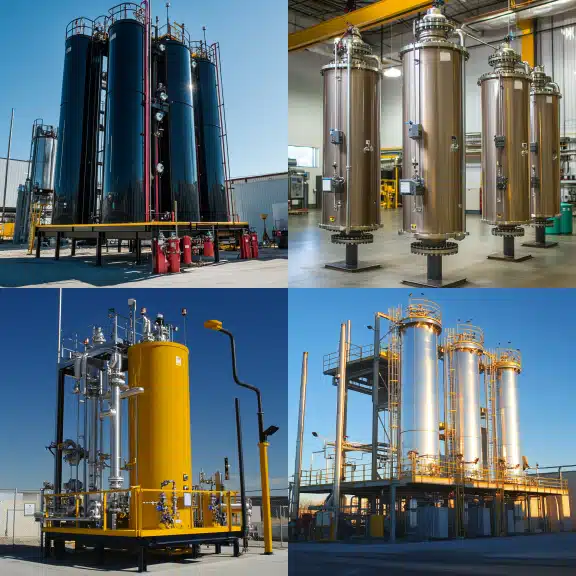
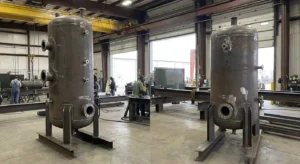
Vertical Separators for Industrial Applications play a crucial role in improving efficiency, product purity, and operational reliability across many processing environments. These vessels support consistent separation performance, reduce maintenance demands, and enhance overall plant productivity. With durable construction and dependable quality, vertical separators remain a preferred solution for industries that rely on stable fluid-handling operations.
The Vertical Separators
Vertical separators play a vital role in a variety of industrial applications, especially in the oil and gas industry. At Red River, we emphasize efficiency and reliability to help optimize your operations. That’s why we proudly offer some of the finest vertical separators that meet the highest industry standards.
Overview of Vertical Separators in Industrial Applications
Vertical separators efficiently separate liquids from fuels across various industrial processes. Their primary function is to ensure proper separation of gasoline, oil, and water before further processing. This process maintains manufacturing integrity, prevents costly downtimes, and ensures smooth operations.
Importance of Understanding Vertical Separator Operations
To maximize the performance and lifespan of a vertical separator, it’s crucial to understand its operation. These devices rely on gravity and fluid density differences for separation. Heavier liquids sink to the bottom, while lighter fluids like gasoline rise to the top. This natural separation process is enhanced by internal components such as baffles and mist extractors, ensuring efficient operation with minimal power usage.
How Does a Vertical Separator Work?
Knowing how a vertical separator functions is key to achieving optimal performance in industrial applications. At Red River, we aim to simplify complex processes for you. By understanding each component’s role, you can make well-informed decisions to address your system’s specific needs.
Key Components of a Vertical Separator
A vertical separator features several key components that work together to achieve optimal separation. These include the inlet diverter, which directs incoming mixtures; the gravity settling segment, where separation occurs; and the mist extractor, which removes residual liquid droplets. Engineers design these components to ensure the separation process is both efficient and reliable.
Step-by way of-Step Working Mechanism
The separation process starts as mixed fluids enter the separator through the inlet diverter, initiating the separation. Gravity then pulls heavier liquids to the bottom while gases rise to the top. The mist extractor captures any remaining liquid droplets, ensuring that only clean gas exits through the top outlet and separated liquid collects at the bottom.
Advantages of Using Vertical Separators
Vertical separators offer multiple benefits, including efficient space utilization, effective fluid level separation, and adaptability to varying operating conditions. Their design enables high-capacity processing with minimal energy use, making them an excellent choice for industries focused on efficiency and reliability. Choosing Red River for your vertical separator means investing in a solution designed to deliver results.
Applications of Vertical Separators
Vertical separators are versatile and play an essential role in various industrial applications. Their ability to separate fluids at different stages makes them vital for industries requiring precise separation. At Red River, we design vertical separators tailored to meet the demands of diverse industries, ensuring optimal performance and reliability.
Vertical Separators within the Oil and Gas Industry
In the oil and gas industry, vertical separators process the mixed flow of hydrocarbons extracted from wells. These separators isolate oil, fuel, and water, which is essential for both upstream and downstream operations. By separating these phases, vertical separators maintain product purity, reduce the risk of pipeline corrosion, and enhance overall production efficiency. At Red River, we design vertical separators to endure harsh oil and gas field conditions, delivering reliable performance and extended service life.
Use Cases in Filtration and Separation Processes
Beyond oil and fuel, vertical separators find applications in industries requiring efficient filtration and separation. For instance, in power generation, they separate steam from water to ensure optimal turbine operation. In chemical processing, vertical separators remove contaminants and achieve desired product purity. Their compact design and superior performance make them ideal for applications where space and reliability are paramount. At Red River, we tailor vertical separators to meet your enterprise’s specific needs, providing exceptional performance across all separation tasks.
Industries That Benefit from Vertical Separators
Vertical separators support a wide range of industrial environments that rely on consistent material management. These vessels are used in areas where fluid handling, phase separation, and downstream equipment protection are central to operational success.
Need a reliable partner?
Red River specializes in the design and manufacturing of pressure vessels. We also fabricate related items such as prefabricated spools and skid packages.
Reach Out to us today and experience the Red River difference. Where American Made and American Values come together, we care more.
Frequently Asked Questions
1. What makes vertical separators effective in industrial operations?
Vertical separators are effective because their design promotes natural phase settling, leading to consistent separation performance that supports operational stability.
2. How do vertical separators protect downstream equipment?
These vessels help maintain proper material separation, limiting contamination and reducing stress on pumps, compressors, and other system components.
3. Are vertical separators suitable for multi-phase systems?
Yes. Their internal configuration supports dependable management of multi-phase materials, allowing stable process flow and improved output quality.
4. What contributes to the durability of a vertical separator?
Strong construction materials, quality welding, and proven internal designs contribute to long-term dependability in demanding industrial environments.
5. Why do many facilities choose vertical separators over horizontal units?
Facilities often select vertical separators when they need a compact footprint, stable separation under variable conditions, and simplified internal accessibility.
Key Takeaways
- Vertical separators provide stable and efficient phase separation for many processing environments.
- Their compact, upright design supports effective material handling and equipment protection.
- Internal components help improve separation clarity and reduce system interruptions.
- These vessels support operational consistency and long-term reliability across various applications.
- High-quality fabrication ensures dependable performance and reduced maintenance concerns.
Related Blog Post
Which Materials Suit Make-Up Water Service?
How Big Should Make-Up Water Tanks Be?
Make-Up Water Tanks: Design, Sizing, and Fabrication
When to Spec Equalization Tanks for Industrial Systems
How Do Equalization Tanks Balance Flow?
No subpillar set for this blog post.
About Author



