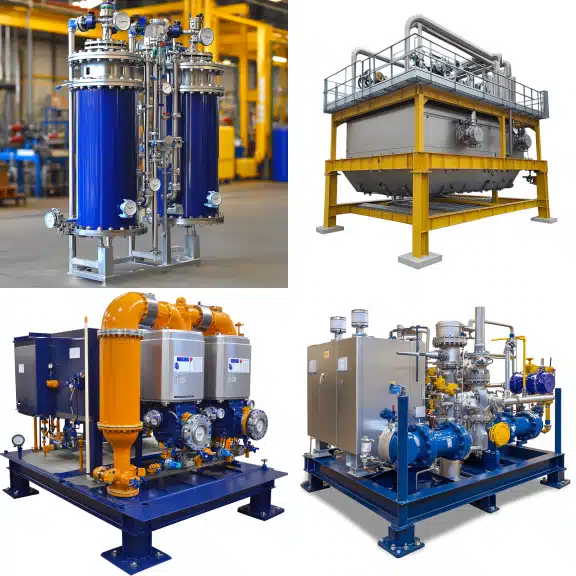
Separators are essential in industrial processes for efficiently splitting mixtures into usable components especially in sectors like oil & gas, wastewater treatment, and chemical processing. By leveraging gravity or centrifugal force, they isolate liquids, gases, and solids, improving product quality, reducing waste, and supporting sustainability. Choosing the right separator and maintaining it well is key to long-term performance and environmental impact.
The Separator in Industrial Processes
In industrial processes, separators play a critical role in ensuring efficiency and sustainability. At Red River, we know that efficiency drives any successful business operation. One often-overlooked hero of these systems is the separator. But what exactly is a separator, and why is it crucial across various industries?
What Is a Separator?
A separator is a system designed to divide debris, liquids, or gases into distinct components. These devices are vital in industries ranging from oil production to chemical processing and waste control. Their main function is to ensure different phases of a mixture are separated properly. This enhances the purity and usefulness of each component. Learn more about how separators function in industrial settings in our guide on separator efficiency for better operations.
Key Functions of a Separator in Oil and Gas Operations
In the oil and fuel sector, separators play a key role during the early stages of processing. They isolate crude oil from gasoline and water, ensuring products meet quality standards before further processing or transportation.
Separators function using variations in density and gravity to separate oil, gas, and water into streams. This process protects pipelines, reduces corrosion risks, and improves the final product’s quality. For an in-depth look at similar separation technologies, see our introduction to oil-water separation coalescers.
How Does a Separator in Industrial Work? The Mechanics Explained
At its core, separation combines science and engineering to efficiently split unique parts of a mixture. Understanding how separators work sheds light on why they are vital to so many industries.
The Science Behind Separation in Industrial Processes
The principle behind separation is simple yet effective. Separators utilize variations in physical properties, such as density and particle size, to separate components. Centrifugal force is often applied to accelerate the process, forcing heavier materials outward while lighter ones move toward the center. This principle is applied in both gravity and centrifugal separators to ensure clean and precise separations. More details on separation mechanics are available in our understanding the basic principle of separator work article.
Types of Separators in Industrial Processes and Their Applications
Different industrial processes require different types of separators. Gravity separators rely on the natural settling of heavier materials, making them ideal for separating solids and liquids in wastewater treatment. Centrifugal separators are used in high-speed processes like oil refining, where rapid separation of liquids and gases is necessary. For a technical comparison, explore the difference between 2-phase and 3-phase separators.
Step-through-Step Process of How a Separator Operates
A separator works by first receiving the mixed input through an inlet. As the mixture enters, centrifugal force or gravity acts upon it, pushing denser components outward or downward, while lighter elements rise or move inward. The separated materials are then channeled into distinct outlets, ensuring each component can be processed or used separately without contamination. For more context on the operational principles, see meaning of retention time in separators.
Benefits of Using a Separator in Industrial Processes
Separators are quintessential in commercial methods, providing quite several advantages that decorate both operational efficiency and environmental sustainability. Understanding these blessings lets you see why investing in notable separators is critical for your enterprise.
Efficiency and Cost-Effectiveness
One of the primary advantages of a separator is its ability to increase operational efficiency. By accurately isolating components based on density, particle size, or other physical properties, separators streamline processes and reduce the need for additional handling or processing steps. This accelerates production and minimizes waste, resulting in significant cost savings. For related industrial process insights, check our distillation and separation guide.
Environmental Impact and Sustainability
Separators also support environmental sustainability. By ensuring contaminants are effectively removed, they help reduce pollution and minimize the environmental footprint of industrial operations. For example, in wastewater treatment, separators remove impurities before water is released back into the environment, protecting ecosystems and public health. Clean separation techniques also facilitate resource recovery and recycling, promoting sustainable practices. To explore complementary separation technologies, see understanding what particles can be separated through filtering.
Partner with Red River for Reliable Separation Solutions
Maximize efficiency, reduce waste, and support sustainability in your operations with expertly designed separators. At Red River, we specialize in custom pressure vessels, prefabricated spools, and skid packages built for performance and durability.
Contact us today to explore how our American-made solutions can elevate your industrial processes and ensure long-term operational success.
Frequently Asked Questions
1. What kinds of industries typically use separators?
Separators are used throughout a wide variety of industries due to their versatility and efficiency. Some of the most common industries encompass oil and gasoline, chemical processing, wastewater remedy, meals and beverage, pharmaceuticals, and energy generation. In the oil and gas enterprise, separators are important for isolating crude oil from gasoline and water. In chemical processing, they help in purifying chemicals by keeping apart contaminants. Wastewater remedy vegetation uses separators to put off stable waste from the water, making sure clean water is again to the environment. The food and beverage industry makes use of separators to refine products like milk or juice, and in pharmaceuticals, separators ensure the purity of medicines. Each enterprise tailors the use of separators to meet particular operational desires, making them a necessary device in industrial strategies.
2. What are the key elements to bear in mind when selecting a separator for a business application?
When selecting a separator, numerous key elements should be considered to make sure it meets the precise necessities of the software. These elements consist of the nature of the substances being separated, consisting of their density, viscosity, and particle size. The desired stage of purity and separation efficiency is likewise vital, as exceptional programs may additionally require various levels of precision. Additionally, the running situations, consisting of temperature, pressure, and go-with-the-flow price, play a widespread role in determining the appropriate separator. The form of separator whether it’s a gravity separator, centrifugal separator, or another type ought to align with the specific desires of the manner. Finally, issues along with maintenance necessities, energy consumption, and value-effectiveness are essential to make certain lengthy-time period operational performance.
3. How does the preservation of separators impact their overall performance and durability?
Regular protection of separators is essential to ensure their most advantageous performance and toughness. Without proper maintenance, separators can revel in problems such as clogging, wear and tear on moving parts, and reduced efficiency in keeping apart additives. Routine inspections, cleaning, and alternative worn parts are important to prevent these troubles. Additionally, ensuring that separators are operated inside their designed parameters can enlarge their lifespan and decrease the frequency of renovation desires. Maintenance schedules should be based totally on the particular sort of separator and the situations below which it operates. By adhering to a strict maintenance routine, industries can avoid high-priced downtimes and ensure that their separators are carried out effectively.
4. What are the environmental advantages of using separators in industrial strategies?
Separators offer extensive environmental advantages using enhancing the efficiency of waste control and aiding recovery in industrial techniques. For instance, in wastewater remedy, separators do away with contaminants from water earlier than it’s miles discharged, defensive herbal water our bodies and ecosystems. In the oil and fuel industry, separators help prevent the release of harmful materials by efficiently separating and capturing them for proper disposal or recycling. Additionally, separators can reduce the general environmental footprint of an operation utilizing minimizing waste and maximizing the recuperation of treasured sources. These benefits make separators a key aspect in promoting sustainable practices across numerous industries.
5. How does a centrifugal separator fluctuate from a gravity separator?
Centrifugal and gravity separators both serve the motive of keeping apart additives based totally on differences in density, however, they perform the usage of distinct concepts. A gravity separator relies on the natural force of gravity to separate heavier and lighter additives inside a mixture. It is typically utilized in programs wherein the separation procedure can take the area over a longer period, including in sedimentation tanks in wastewater treatment. On the opposite hand, a centrifugal separator makes use of centrifugal force generated through a rotating detail to boost up the separation manner. This makes centrifugal separators ideal for applications requiring rapid and precise separation, such as in the refining of oils or excessive-pace chemical processing. The desire for a centrifugal and gravity separator depends on the unique requirements of the industrial technique, along with the rate of separation desired and the nature of the materials involved.
Key Takeaways
- Separators are critical devices used to split mixtures into individual components like gas, oil, water, or solids.
- Industries such as oil & gas, wastewater treatment, chemical processing, and pharmaceuticals rely on separators for efficiency and product purity.
- Types of separators include gravity-based (slower but effective) and centrifugal (faster, more precise) systems.
- Core benefits include improved operational efficiency, reduced processing time, minimized waste, and enhanced environmental sustainability.
- Proper selection depends on material properties (density, viscosity), required purity, operating conditions, and maintenance needs.
- Routine maintenance is essential to ensure long-term performance, prevent clogs, and avoid costly downtime.
- Environmental impact is significantly reduced by using separators, which help prevent pollution and promote sustainable resource recovery.
Related Blog Post
Which Materials Suit Make-Up Water Service?
How Big Should Make-Up Water Tanks Be?
Make-Up Water Tanks: Design, Sizing, and Fabrication
When to Spec Equalization Tanks for Industrial Systems
How Do Equalization Tanks Balance Flow?
- Separator Technology: Innovations for Industry & Science
- Understanding the 2 Types of Oil Water Separator
- Understanding the Difference Between Distillation and Separator
- Understanding the Purpose of a Water Separator
- Understanding Two-Phase Fluid Dynamics
- Understanding the Role of a 2-Phase Separator in Industrial Processes
About Author