
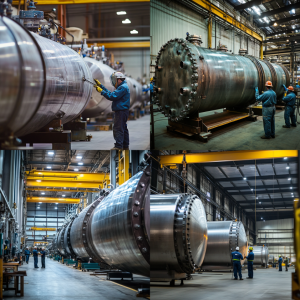
The ISO standard for pressure vessels (ISO 16528) ensures that pressure vessels meet rigorous safety and performance benchmarks, promoting global consistency and reliability. Adhering to this standard allows manufacturers to produce vessels that can safely handle high pressures and harsh conditions while meeting international trade and regulatory requirements.
Understanding the ISO Standard for Pressure Vessels and Its Role in Manufacturing
Pressure vessels are critical components in a wide range of industries energy, chemical processing, oil and gas, manufacturing, and more. Because they store and transport pressurized gases and liquids, the consequences of design or fabrication failure can be catastrophic. That’s why global standards, especially the ISO standard for pressure vessels, are essential.
The International Organization for Standardization (ISO) develops and publishes standards to ensure quality, safety, efficiency, and interoperability. Based in Geneva, Switzerland, ISO has issued over 25,000 international standards, many relevant to industrial applications like pressure vessels. These standards serve as a common language across countries and industries, helping ensure that equipment meets performance and safety expectations no matter where it is manufactured or used.
For pressure vessels, ISO guidelines enhance reliability, mitigate risk, and ensure vessels meet the ISO standard for pressure vessels. They help manufacturers build vessels that perform safely under high pressure, survive harsh conditions, and comply with local and international codes.
Key ISO Standards for Pressure Vessels
Among the ISO documents affecting pressure equipment, ISO 16528 is the most prominent.
What is the ISO Standard for Pressure Vessels (ISO 16528)?
ISO 16528, titled Boilers and Pressure Vessels, provides a framework for evaluating the design, fabrication, inspection, and certification of pressure vessels to ensure they are safe and fit for service.
It consists of two parts:
- ISO 16528-1: Performance requirements
- ISO 16528-2: Procedures for fulfilling the requirements of ISO 16528-1
These documents don’t prescribe specific design rules or manufacturing steps. Instead, they lay out performance-based requirements allowing different national codes (ASME, EN, JIS) to demonstrate equivalency. This unifies international expectations without enforcing one-size-fits-all rules. Learn more about ASME vs ISO standards.
Related ISO Standards for Pressure Vessels
Other relevant ISO standards for pressure vessel manufacturing include:
- ISO 9001: Quality management systems
- ISO 3834: Quality requirements for fusion welding
- ISO 11439: High-pressure cylinders for natural gas vehicles
- ISO 11120: Refillable seamless steel tubes
For a broader overview, see our guide to pressure vessel standards.
Why the ISO Standard for Pressure Vessels Matters
The role of the ISO standard for pressure vessels goes beyond ticking boxes for regulatory compliance. It is instrumental in engineering excellence, risk management, and market competitiveness.
Ensuring Safety
Pressure vessels operate under dangerous conditions. Failure can cause injury, environmental damage, and financial loss. ISO sets detailed safety expectations, covering design margins, testing procedures, materials, and documentation. Vessels aligned with ISO:
- Withstand operational stress and fatigue
- Are leak-proof under specified pressures
- Resist corrosion, erosion, and extreme temperatures
Driving Consistency
ISO standards provide a baseline of quality across projects, teams, and locations. Whether a vessel is fabricated in North America or Southeast Asia, ISO alignment ensures:
- Reduced errors and rework
- Enhanced operational efficiency
- Confidence in outsourced components
Facilitating Global Trade
ISO-compliant vessels simplify international procurement, vendor qualification, and third-party inspections. For multinational companies or EPC firms, ISO conformance reduces red tape and speeds up project timelines.
Enhancing Customer Trust
Clients often seek suppliers with ISO-aligned processes, signaling discipline, transparency, and reliability. At Red River, we embrace the ISO standard for pressure vessels as part of our philosophy: “Do it right. Every time.”
ISO Compliance vs. Certification: What’s the Difference?
This is a key point of confusion for many professionals.
- ISO Compliance: Following ISO principles without formal third-party auditing.
- ISO Certification: Formal audit by an accredited body, resulting in an official certificate.
Which one is necessary depends on industry regulations, client requirements, and risk profile. At Red River, we support clients needing ASME-compliant vessels, ISO-aligned documentation, or a hybrid approach.
ISO Standards: A Global Language of Safety and Quality
Pressure vessels serve high-risk, high-reliability industries. That’s why using global standards like the ISO standard for pressure vessels isn’t just good practice, it’s good engineering.
While regional codes like ASME or PED dictate specific design rules, ISO sets the performance criteria that allow different standards to be compared and harmonized. It’s the bridge between national regulations and global operations.
In a world where safety, quality, and efficiency are non-negotiable, ISO standards help manufacturers and clients speak the same language, no matter where they’re located.
The Importance of Adhering to the ISO Standard for Pressure Vessels
In today’s globalized industry, adhering to the ISO standard for pressure vessels is more than just a regulatory necessity; it is a commitment to safety, quality, and reliability. The ISO standard for pressure vessels sets the global benchmark for designing, fabricating, and testing pressure vessels. By embracing these standards, manufacturers can ensure that their vessels perform safely under high pressures, withstand extreme conditions, and meet international trade and regulatory requirements. At Red River, we believe in the importance of these standards and work diligently to incorporate them into every aspect of our manufacturing process, ensuring the highest level of quality and safety for our clients worldwide.
Get in Touch with Red River for ISO-Compliant Pressure Vessels
If you need pressure vessels built to ISO standards, Red River is your trusted partner. Our ISO-aligned fabrication process ensures vessels that perform reliably under the most demanding conditions.
Contact us today to learn more about our solutions and how we can meet your specific needs.
Frequently Asked Questions
1. What is the ISO standard number for pressure vessels?
The main ISO standard for pressure vessels is ISO 16528, titled Boilers and Pressure Vessels. It provides performance-based requirements for design and fabrication to ensure the vessels’ safety and reliability.
2. Does ISO 16528 replace ASME or other national codes?
No, ISO 16528 does not replace national codes such as ASME, EN, or JIS. Instead, it complements these codes by establishing performance benchmarks, allowing for international equivalence.
3. Is ISO certification required for all pressure vessels?
ISO certification is not required for all pressure vessels. It depends on regulatory mandates, industry requirements, or customer specifications. However, adhering to ISO standards is often recommended for ensuring quality and safety.
4. What is the benefit of ISO-compliant pressure vessels?
ISO-compliant pressure vessels meet high safety and performance standards, which increases customer confidence and simplifies international trade and certification processes.
5. Can a pressure vessel be both ASME and ISO compliant?
Yes, many pressure vessels are both ASME-compliant and ISO-compliant, particularly for international projects that require conformity to multiple standards.
Key Takeaways
- The ISO standard for pressure vessels, specifically ISO 16528, is the global benchmark for pressure vessel design, fabrication, and inspection. It sets performance requirements to ensure vessels are safe, reliable, and fit for service.
- ISO compliance ensures that pressure vessels meet high safety and quality standards, which are essential for global trade, risk management, and market competitiveness.
- The ISO standard for pressure vessels is designed to complement national codes like ASME and EN, allowing for international equivalence while maintaining local regulatory requirements.
- Adopting ISO standards ensures consistency in manufacturing processes across different teams and locations, leading to fewer errors, less rework, and better operational efficiency.
- ISO certification and ISO compliance are essential for ensuring the integrity of pressure vessels, but the need for certification depends on industry regulations, client requirements, and project specifications.
Related Blog Post
Which Materials Suit Make-Up Water Service?

How Big Should Make-Up Water Tanks Be?
Make-Up Water Tanks: Design, Sizing, and Fabrication
When to Spec Equalization Tanks for Industrial Systems
How Do Equalization Tanks Balance Flow?
No subpillar set for this blog post.
About Author



