
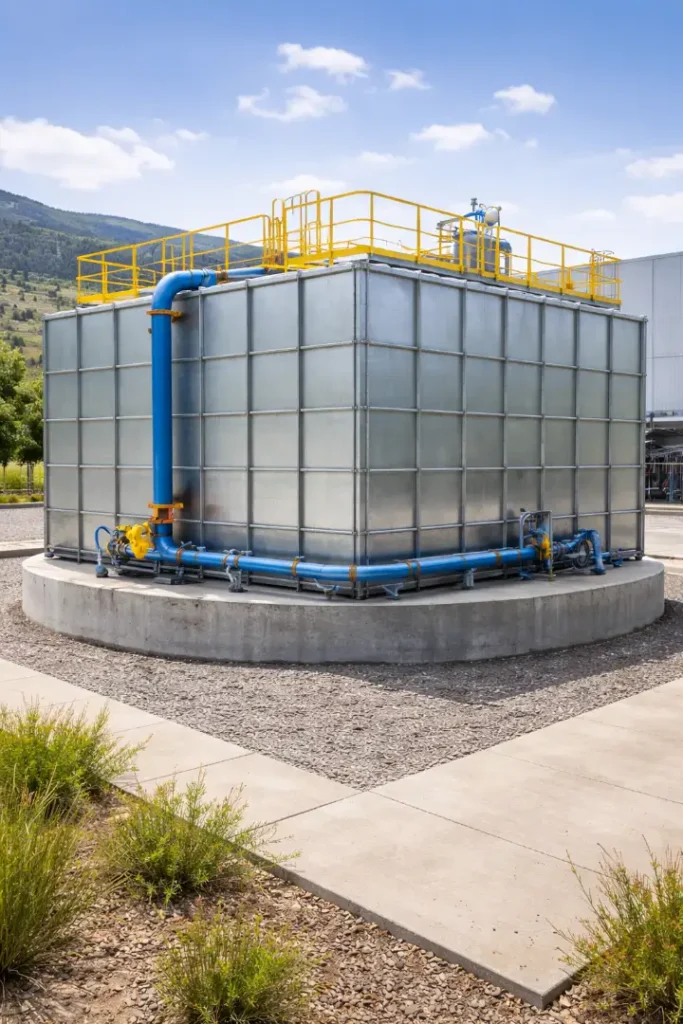
Seismic zone classification changes anchor sizing, panel thickness, ringwall design, and piping specs on modular tanks before a single plate gets cut. This guide is written for engineers, project managers, and procurement leads scoping modular tanks in seismic-active regions. You will leave with a clear picture of how ASCE 7 categories translate into real design decisions, cost premiums, and fabrication requirements.
Modular tanks have more connection points than single welded vessels, which means seismic zone classification drives real engineering decisions on anchor sizing, panel thickness, ringwall geometry, and piping specs long before fabrication starts. This guide is written for engineers, project managers, and procurement leads scoping modular tanks in seismic-active regions.
Why Seismic Design Matters More on Modular Tanks
Modular tanks are built in sections and assembled in the field, which creates more connection points than a single welded vessel. Every seam, bolt pattern, and anchor point has to resist lateral motion during a seismic event. That changes the engineering math compared to a monolithic tank where the structure moves as one.
The risk is not theoretical. A poorly anchored modular tank in a high-seismic zone can shift off its foundation, shear panel bolts, or rupture at the base seam. The fix is rarely simple and almost never cheap. Getting the seismic spec right during design is the only path that actually works.
Red River Co has built modular tanks for sites across the Powder River Basin and into higher-seismic regions for over 21 years. Every design gets run through the governing seismic calcs before fabrication starts.
ASCE 7 Categories and What They Mean for Your Tank
The seismic design code most tank projects follow in the United States is ASCE 7, which sorts sites into six seismic design categories (A through F). Category A sites sit in low-risk regions with minimal ground acceleration. Category F covers critical structures in the highest-risk zones.
For modular tanks, the categories that drive the biggest engineering changes are C, D, E, and F.
Categories A and B: Standard Design Applies
Most of Wyoming, the northern plains, and parts of the Midwest fall into Category A or B. Standard modular tank designs handle these zones without significant modification. Anchor sizing, panel thickness, and ringwall specs follow the manufacturer’s baseline engineering.
Category C: Moderate Reinforcement
Category C is where seismic starts influencing real design decisions. Anchor bolt diameter typically increases by one size, base panels get thicker to resist shear at the foundation interface, and ringwall steel reinforcement goes up. The cost premium over baseline is usually 5 to 10 percent.
Categories D, E, and F: Heavy Engineering Required
Sites in California, parts of the Pacific Northwest, and select zones in the Mountain West land in Category D or higher. These projects need:
- Oversized anchor bolts, often stainless or high-strength alloy
- Stiffened base panels with additional weld reinforcement or bolted splice plates
- Reinforced concrete ringwalls with upgraded rebar density
- Flexible connections on all inlet and outlet piping to absorb movement
- Base isolation systems on the most critical installations
The cost premium in Category D and above can run 15 to 30 percent over baseline, but skipping the upgrades is not an option. The code is not optional, and neither is the insurance implication.
How Seismic Limits Affect Each Part of the Tank
Seismic design touches every major component. Understanding where those changes land helps engineers scope the project accurately.
Anchor Bolts and Hold-Down Hardware
Anchor bolts are the first line of defense. In high-seismic zones, bolt diameter, embedment depth, and pattern spacing all scale up. A tank that uses 3/4-inch anchors in Category B might step up to 1-1/4 inch in Category D, with embedment depth doubling to resist pullout loads.
The pattern matters as much as the size. Evenly distributed anchors around the tank circumference perform better than clustered patterns under cyclic seismic loading.
Panel Thickness and Seam Design
Bolted modular tanks rely on gasket seals that must maintain compression under lateral loads. In high-seismic zones, panel thickness increases to resist deformation, and seam bolt torque specs tighten. Welded seam modular tanks add radiographic testing on field-assembled seams to confirm weld integrity under expected loading.
Foundation and Ringwall Design
Ringwall geometry matters beyond just material specs. A narrow ringwall that meets minimum width for a standard installation may not distribute base shear adequately in a Category D or higher event. Wider ringwalls with continuous rebar mats and deepened footings handle the eccentric loading that ground motion events introduce at the tank base. If your civil contractor is sizing the ringwall independently without load data from the tank fabricator, that gap is where spec errors happen.
Piping Tie-Ins
Rigid pipe connections are a failure point under seismic loading. Flexible joints, expansion loops, and seismic-rated pipe supports absorb movement and protect the tank from transferring stress into the piping system. Every tie-in gets spec’d for the site’s seismic category.
Need to scope a modular tank for a seismic-active site? Request a quote from Red River or call 1-307-257-5332 to walk through anchor sizing, foundation loads, and timeline for your specific site.
How the Design Review Process Handles Seismic
Seismic calcs are not an afterthought on a Red River design. They run in parallel with the capacity, material, and service-condition calcs during the initial design review. Three inputs drive the seismic engineering:
- Site latitude and longitude: Ground acceleration values come directly from USGS seismic hazard maps based on exact coordinates
- Soil classification: Site soil stiffness amplifies or dampens ground motion, so geotechnical data feeds directly into the design
- Risk category of the facility: A tank serving a hospital or emergency response site carries a higher importance factor than one at a general industrial facility
Our drafting team runs the full calc set in 3D before any plate is cut. Clients see the seismic design basis during review, not after fabrication. That front-loaded process catches ringwall and anchor specs early, before they become expensive changes in the field.
Common Seismic Mistakes to Avoid
Three patterns show up repeatedly on troubled seismic projects, and all three are preventable.
Mistake 1: Using generic anchor specs from a catalog. Standard anchor packages ship with many tanks, but they are not engineered for any specific site. Every seismic-active site needs anchors calculated to local ground acceleration and soil class.
Mistake 2: Treating the foundation as someone else’s problem. The civil contractor builds the ringwall, but the tank fabricator owns the load data. If those two parties are not coordinating directly, the spec drifts and the foundation ends up either over- or under-designed.
Mistake 3: Skipping flexible piping connections. The tank can survive the seismic event and still fail the facility if rigid piping snaps at the nozzle. Flexible tie-ins are cheap insurance against a very expensive failure mode.
Ready to Spec for Your Seismic Zone?
If you are scoping a modular tank for a seismic-active site, the smartest next step is a fabrication review with engineers who run these calcs every day. Request a quote from Red River or call 1-307-257-5332 to walk through your site, soil class, and risk category before the design gets locked in.
Frequently Asked Questions
1. When are modular tanks better than single tanks?
Modular wins on restricted sites, when transport permits get costly, or when capacity needs to scale in phases. Single tanks stay better for open sites with static capacity.
2. What documentation speeds modular tank approval?
Mill certs, weld procedures, welder qualifications, hydrotest records, and a manufacturer’s data report cover most inspector questions. For ASME builds, add the U-1 form and National Board registration.
3. How does soil class affect modular tank seismic design?
Soft soils amplify ground motion and require heavier anchors and thicker ringwalls, while stiff rock sites dampen the motion and allow lighter specs. Geotechnical data is mandatory for any seismic-active site.
4. Can an existing modular tank be retrofitted for higher seismic loads?
Sometimes. Anchor upgrades and piping retrofits are usually feasible, but panel thickness and ringwall reinforcement are harder to change after installation. Designing to the correct spec from the start is always cheaper.
5. What documentation do inspectors want on seismic-designed tanks?
Seismic calc packages, anchor pull test records, foundation inspection reports, and a signed design basis memo from the engineer of record cover most inspector questions on day one.
Key Takeaways
- Pull your site’s ASCE 7 seismic design category before scoping a modular tank, because it drives anchor sizing, panel thickness, and foundation specs across the whole project
- Budget 5 to 10 percent cost premium for Category C sites and 15 to 30 percent for Category D and above, compared to baseline modular designs
- Confirm your fabricator runs seismic calcs based on exact site coordinates and soil class, not generic regional assumptions
- Coordinate ringwall design directly between the tank fabricator and civil contractor to avoid foundation spec drift
- Specify flexible piping connections at every nozzle on seismic-active sites to protect the tank and the facility
Related Blog Post
Can Condensate Storage Improve Reliability?
Where Do Condensate Tanks Fit in a Steam System?
Which Nozzles Simplify Maintenance on Pressure Vessels?
How to Vent Condensate Tanks in Steam Systems
How Do Baffle Layouts Affect Stratification in TES Tanks?
About Author



