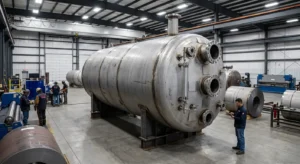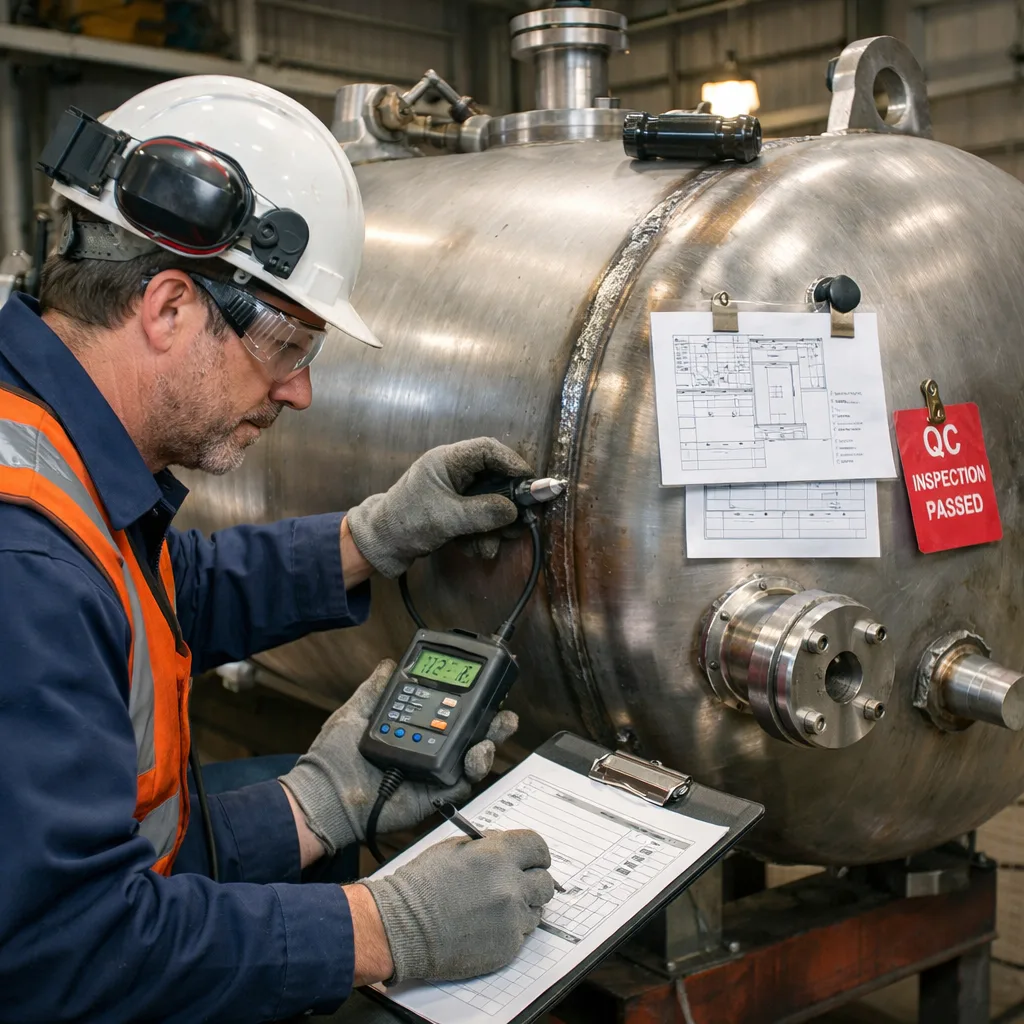
Embedded OEM quality control integrates inspection, testing, and documentation into every stage of pressure vessel manufacturing, ensuring safety, compliance, and consistent performance from design through delivery. This proactive approach reduces rework, improves traceability, meets strict OEM and ASME requirements, and enables faster, more reliable production without sacrificing efficiency.
Why Embedded OEM Quality Control Is Critical to Production
Embedded OEM quality control in pressure vessel manufacturing is the foundation for delivering reliable, compliant, and high-performing vessels at scale. In specialized operations like pressure vessel manufacturing, quality must be engineered into every phase. From raw material verification to in-process monitoring and post-weld inspections, embedded OEM quality control ensures that quality is not treated as a final step but as a continuous, integrated process woven throughout fabrication.
As OEM clients increasingly demand repeatability, traceability, and faster production cycles, manufacturers with advanced pressure vessel manufacturing processes are better positioned to meet those expectations. By maintaining rigorous oversight from design to delivery, manufacturers ensure every vessel meets industry requirements for safety, performance, and compliance while supporting scalable production through integrated fabrication capabilities.
Integrating Quality from Design to Delivery
Embedded quality control in OEM pressure vessel manufacturing begins at the design stage, where early decisions directly impact long-term reliability and compliance. Proper planning aligns with best practices outlined in pressure vessel design and safety standards.
Key quality activities at this stage include:
- Design Verification confirming drawings comply with ASME requirements and OEM specifications, supported by guidance on ASME-certified pressure vessels.
- Material Selection Checks validating MTRs against approved grades using insights from choosing the right material for pressure vessel fabrication.
- Manufacturing Plan Reviews establishing QA and QC workflows aligned with documented pressure vessel fabrication processes.
Early integration of quality minimizes costly rework and reinforces consistency throughout custom builds and modular systems such as modular skids.
Real-Time Inspection During Fabrication
Embedded quality control continues throughout fabrication, especially in environments focused on metal fabrication and high-pressure applications.
Critical real-time inspections include:
- Fit-Up and Tack Weld Inspections ensuring proper joint preparation consistent with vessel welding joint preparation best practices.
- In-Process Welding Checks validating heat input and technique in line with pressure vessel welding procedures.
- Dimensional Verification confirming tolerances after rolling, forming, and assembly, aligned with pressure vessel manufacturing and inspections.
- Welder Qualification Monitoring ensuring personnel meet certification standards outlined in pressure vessel welding certification requirements.
These checkpoints support compliance with ASME Section VIII and enhance reliability across OEM production lines.
Non-Destructive Testing (NDT) Integration
One of the most critical elements of embedded quality control in OEM pressure vessel manufacturing is non-destructive testing. Effective NDT aligns with practices detailed in the comprehensive guide to pressure vessel inspection.
Common NDT methods include:
- Ultrasonic Testing (UT) for internal flaws in welds and plates.
- Radiographic Testing (RT) for X-ray analysis of critical seams.
- Liquid Penetrant and Magnetic Particle Tests for surface defects.
- Hydrostatic Pressure Tests to validate vessel strength, supporting insights from mastering pressure vessel pressurization.
Scheduling NDT throughout production rather than only at final inspection reinforces continuous quality assurance.
Documentation and Digital Traceability
Embedded OEM quality control relies heavily on complete documentation and traceability, which is essential for audits, long-term service, and compliance. Manufacturers aligned with quality assurance in custom pressure tank manufacturing prioritize digital recordkeeping.
Key documentation includes:
- Weld Logs tracking personnel, procedures, and materials.
- Inspection Reports covering each QA and QC checkpoint.
- Material Certifications supporting traceability as outlined in pressure vessel certification standards.
- Digital Tracking Systems connecting vessels to records through QR codes and serialized data.
This level of traceability supports OEM audits and regulatory reviews while improving lifecycle maintenance.
Final Verification and Pre-Delivery Audits
Before shipment, embedded OEM quality control includes a structured pre-delivery audit process similar to those used for industrial pressure vessels.
Final verification steps include:
- Dimensional inspections confirming OEM specifications.
- Hydrostatic and pressure testing for operational integrity.
- NDT inspections to detect internal or surface defects.
- Weld quality verification aligned with ASME pressure vessel standards.
- Material certification review ensuring traceability.
- Surface finish and coating inspections supporting corrosion resistance requirements.
OEM clients receive fully inspected vessels that integrate seamlessly into broader industrial solutions.
Building a Culture of Quality in OEM Production
Sustaining embedded quality control requires more than procedures. It requires an organizational culture built around accountability and continuous improvement, supported by experienced teams like those behind Red River’s pressure vessel expertise.
Best practices include:
- Investing in workforce training supported by insights from pressure vessel welding education.
- Encouraging collaboration across engineering, fabrication, and inspection teams.
- Implementing formal QMS frameworks such as ISO 9001 and ASME U-Stamp programs.
- Applying Lean and Six Sigma methodologies to reduce defects and increase repeatability.
Quality becomes embedded when every team member understands its role in the process.
Why Quality Is a Built-In Advantage
Embedded OEM quality control in pressure vessel manufacturing is no longer a luxury—it’s a critical requirement. By embedding inspection, documentation, and validation into every phase of production, manufacturers ensure that quality is built into the process, not just checked at the end. This approach enables them to meet strict compliance standards, protect end users, and reinforce their reputations for precision and reliability.
For OEMs, the value of embedded OEM quality control is clear: it ensures that every pressure vessel delivered is consistent, fully traceable, and engineered to perform at peak levels from the start. In today’s fast-paced, regulation-heavy industrial environment, this integrated quality approach is essential for delivering high-performance, safe, and scalable equipment—without sacrificing speed or efficiency.
Need a reliable partner?
Red River specializes in the design and manufacturing of pressure vessels. We also fabricate related items such as prefabricated spools and skid packages.
Reach out to us today and experience the Red River difference. Where American-made products and American Values come together, we care more.
Frequently Asked Questions
1. What is embedded quality control in OEM pressure vessel manufacturing?
It refers to quality checks and procedures built into each stage of the manufacturing process, from design through delivery.
2. Why is quality control important for OEM pressure vessels?
OEMs require consistent, compliant products. Embedded QC ensures vessels meet technical specs, industry codes, and safety expectations.
3. What types of inspections are performed?
Both in-process inspections and non-destructive testing (like UT and RT) are used to verify structural integrity and compliance.
4. How is documentation handled in embedded quality control?
Every step materials, welds, inspections is logged digitally for traceability, audit readiness, and lifecycle tracking.
5. Can embedded quality control lower manufacturing costs?
Yes. By detecting issues early, embedded QC reduces rework, waste, and production delays, saving money over time.
Key Takeaways
- Embedded quality control in OEM pressure vessel manufacturing ensures safety, reliability, and compliance.
- Quality checks begin at the design stage and continue through real-time fabrication inspections.
- Non-destructive testing and documentation play vital roles in verifying vessel performance and traceability.
- A culture of quality requires investment in training, standards, and process improvement
Related Blog Post
Which Materials Suit Make-Up Water Service?
How Big Should Make-Up Water Tanks Be?
Make-Up Water Tanks: Design, Sizing, and Fabrication
When to Spec Equalization Tanks for Industrial Systems