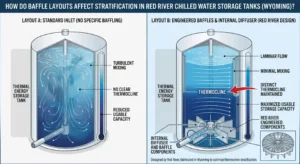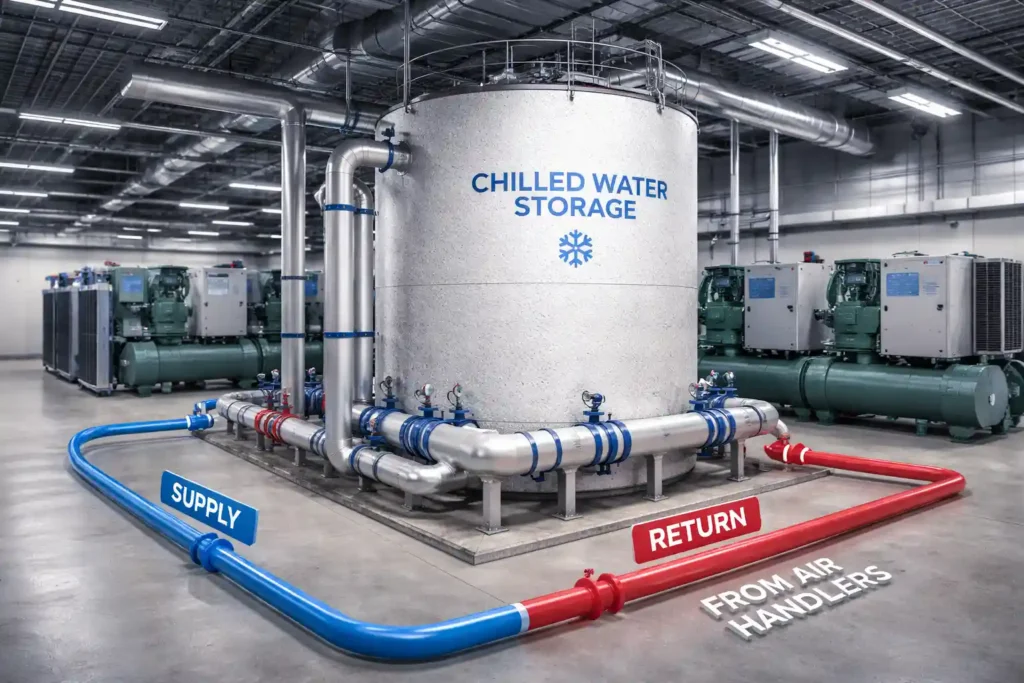
Cooling systems that rely solely on chillers to meet real-time demand face a recurring problem chillers must run at full capacity during peak hours, driving up energy costs and accelerating equipment wear. This guide is for mechanical engineers, facility managers, and energy planners who need to understand what a chilled water storage tank is, how it functions in a hydronic cooling system, and what design decisions determine whether it delivers meaningful operational and cost benefits.
Defining a Chilled Water Storage Tank
A chilled water storage tank is an insulated vessel that stores water cooled to between 40–50°F (4–10°C) for later use in a building or industrial cooling system. Rather than requiring the chiller to produce cold water on demand at every moment, the storage tank holds a reserve of pre-cooled water that can be released into the cooling loop when demand rises.
The core function is thermal decoupling, separating when chilling occurs from when cooling is delivered. This allows energy-efficient operation as the chiller runs under optimal conditions while storage supplies demand later. Chilled water storage tanks are classified as pressure vessels when they operate above 15 psig, requiring ASME Section VIII fabrication and inspection compliance.
How a Chilled Water Storage Tank Works
When the chiller operates typically during nighttime off-peak hours it produces chilled water that is pumped into the storage tank and held at the design supply temperature. The tank is insulated to minimize thermal gain from the surrounding environment.
During peak cooling hours, chilled water is drawn from the storage tank and distributed to air handlers, fan coils, process cooling equipment, or server room cooling units. The water absorbs heat from the space or equipment, returns to the system at a higher temperature, and is either returned to the chiller or recirculated depending on system design.
The key performance variable is delta-T the temperature difference between supply water leaving the tank and return water coming back from the load. A higher delta-T means more cooling energy is extracted per gallon of water circulated. This directly affects how much tank volume is needed to meet a given cooling load. Wider delta-T systems require less storage volume for the same amount of cooling capacity.
For more on how these systems are sized and certified, see ASME code stamped pressure vessels.
Chilled Water Storage Tanks vs Buffer Tanks
These two terms are often used interchangeably but serve different purposes and are sized differently. A chilled water storage tank is designed to hold hours of cooling reserve, sized based on cooling load, discharge duration, and system delta-T. Its main purpose is load shifting by producing chilled water off-peak and discharging it during peak hours to reduce demand charges and chiller runtime.
A buffer tank is sized for minutes of cooling reserve, not hours. Its primary purpose is hydraulic stability, absorbing short-term demand spikes, preventing pump cavitation, and eliminating chiller short cycling when capacity is near minimum load. Buffer tanks are common in variable-flow systems with low-load conditions. Both tank types are often used together in large cooling systems, where the buffer tank manages short transients while the storage tank handles sustained peak demand.
Why Chilled Water Storage Tanks Reduce Energy Costs
The energy savings from chilled water storage come primarily from electricity rate arbitrage and demand charge reduction. Most commercial tariffs include time-of-use pricing, with higher rates during daytime peaks and lower rates at night. By producing chilled water at night and storing it, facilities use cheaper off-peak energy while meeting cooling demand during expensive peak hours.
Demand charges are based on the highest 15- or 30-minute peak consumption reading in a billing period. Chillers are typically the largest contributor to those peak readings. When a storage tank supplies chilled water during peak hours, the chiller’s contribution to the peak reading drops and with it, the monthly demand charge. For facilities where demand charges represent 30–50% of the electricity bill, this reduction can be substantial.
The US Department of Energy provides reference data on thermal energy storage performance in commercial buildings.
Material Selection for Chilled Water Storage Tanks
Material selection determines how long a chilled water storage tank performs reliably without internal corrosion, contamination, or structural degradation. The wrong material choice in a system using glycol or aggressive water treatment chemistry can lead to early failure that eliminates any energy savings the system was designed to generate.
Carbon steel with an internal protective lining is the standard choice for most chilled water storage applications. It is cost-effective, widely available in ASME-approved grades, and performs well in standard treated water systems. Stainless steel grades 304L and 316L are specified where glycol concentrations, low-pH water treatment, or high-purity process requirements create elevated corrosion risk.
All materials used in ASME-certified pressure vessel construction must appear in the approved specifications listed in ASME Section II Part D, which documents allowable stress values for each material at operating temperature.
Need a Reliable Partner?
Red River fabricates ASME U-stamp certified chilled water storage tanks and buffer tanks for data centers, industrial facilities, pharmaceutical plants, and large commercial cooling systems. Every tank is built to specification with full material traceability, certified weld documentation, and hydrostatic test records. Learn more about our fabrication capabilities and quality standards, or contact our team to discuss your project requirements.
What Makes a Chilled Water Storage Tank the Right Choice
A chilled water storage tank earns its place in a cooling system when peak demand charges are a significant cost driver, when chiller capacity cannot meet peak loads in real time, or when redundancy during maintenance is required. The decision to include thermal storage should be based on a load profile analysis that compares the capital cost of the tank against projected savings from demand charge reduction and off-peak chilling over the system’s service life.
Proper sizing, ASME-compliant fabrication, and compatible material selection are the three factors that determine whether the tank delivers on that analysis. Red River works with engineers during the specification phase to validate those decisions before fabrication begins.
Frequently Asked Questions
1. What is the difference between a chilled water storage tank and a buffer tank?
A storage tank holds hours of cooling reserve for load shifting and demand charge reduction. A buffer tank holds minutes of reserve for hydraulic stability and chiller short cycling prevention. Both are often used together in large cooling systems.
2. What temperature is chilled water stored at?
Chilled water is typically stored between 40–50°F (4–10°C), depending on the system’s supply temperature setpoint and the cooling equipment served.
3. How is a chilled water storage tank sized?
Sizing starts with peak cooling load and desired discharge duration. A common starting point is 10 gallons per ton of installed chiller capacity for buffer tanks. Storage tanks are sized based on hours of discharge needed at the system’s design delta-T.
4. Does a chilled water storage tank require ASME certification?
Yes, when the tank operates above 15 psig. Most closed-loop chilled water systems operate between 20–150 psig, placing them under ASME Section VIII Division 1 requirements.
5. What materials are used in chilled water storage tank fabrication?
Carbon steel with internal lining suits most standard applications. Stainless steel 304L or 316L is specified where glycol concentrations or aggressive water treatment chemistry creates elevated corrosion risk.
6. Can chilled water storage tanks be used in data centers?
Yes. Data centers benefit significantly from thermal storage because server loads fluctuate rapidly and peak demand charges are a major cost driver. Storage tanks supply chilled water during peak compute periods without requiring the chiller to run at full capacity.
7. How much volume is needed for chilled water storage?
A common starting point is 10 gallons per ton of installed chiller capacity for buffer tanks. Thermal storage tanks are sized based on desired discharge duration and the delta-T between supply and return
8. Which materials suit chilled water service?
Carbon steel with internal protective lining suits most standard chilled water applications. Stainless steel grades 304L or 316L are specified where glycol concentrations, low-pH water treatment, or high-purity requirements create elevated corrosion risk.
Key Takeaways
- A chilled water storage tank stores pre-cooled water at 40–50°F for later use in cooling systems decoupling chilling production from cooling delivery to reduce peak demand charges and chiller runtime.
- Delta-T between supply and return temperatures is the primary sizing variable a higher delta-T extracts more cooling energy per gallon, reducing the tank volume needed for a given load.
- Chilled water storage tanks differ from buffer tanks in purpose and scale storage tanks hold hours of reserve for load shifting while buffer tanks hold minutes of reserve for hydraulic stability.
- Carbon steel with internal lining suits most chilled water applications stainless steel 304L or 316L is required where glycol or aggressive water treatment creates corrosion risk.
- ASME Section VIII Division 1 applies to chilled water storage tanks operating above 15 psig Red River fabricates U-stamp certified tanks with full material traceability, hydrostatic test records, and certified weld documentation.
Related Blog Post
Can Condensate Storage Improve Reliability?
Where Do Condensate Tanks Fit in a Steam System?
Which Nozzles Simplify Maintenance on Pressure Vessels?
How to Vent Condensate Tanks in Steam Systems