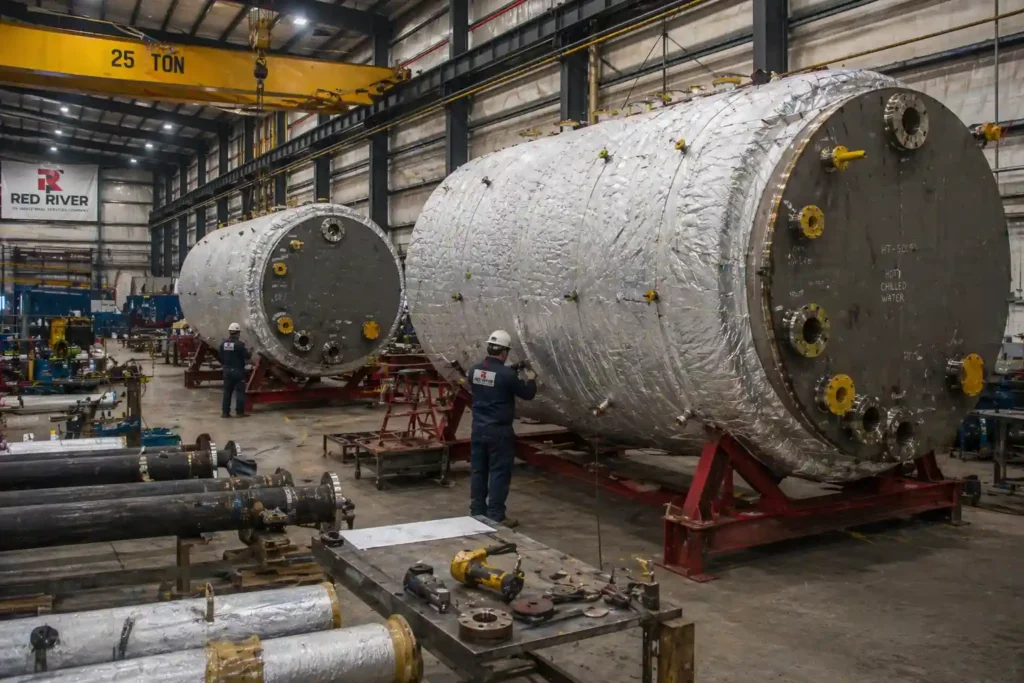
Understanding how does storage shift cooling load is the key to cutting peak demand costs for facility operators and engineers. This guide covers which operating strategy fits your facility and what the fabricated vessel must do to deliver reliable performance over its service life.
The Core Principle Behind Cooling Load Shifting
A conventional chilled water system runs its chillers when the facility needs cooling. Peak cooling demand and peak chiller operation happen at the same time, which means peak electrical demand and peak utility rate exposure also coincide. The chiller plant must be sized to meet the highest demand moment the facility will ever experience, even if that peak only occurs for a few hours each day.
This is how does storage shift cooling load in practice: thermal storage breaks that direct link. The chiller plant runs during off-peak hours, typically overnight, when electricity rates are lowest and ambient temperature is cooler, which improves chiller efficiency. The chilled water produced during those hours is stored in an insulated tank rather than delivered directly to the facility. During peak demand hours, the facility draws cooling from stored capacity instead of running chillers at full load.
The result is a chiller plant sized for average load rather than peak load, a flatter electrical demand profile, and significantly lower utility costs over the operating life of the system. For facilities on demand-charge utility structures, the financial impact can be substantial enough to justify the thermal storage capital investment within a few years. For more on the financial case, see can TES tanks reduce energy costs.
Full Load Shifting Versus Partial Load Shifting
Not every thermal storage system answers how does storage shift cooling load the same way. The two primary operating strategies produce different outcomes depending on the facility’s load profile, utility rate structure, and capital budget.
Full load shifting
The chiller plant operates only during off-peak hours and is taken completely offline during peak rate periods. The storage tank carries the entire facility cooling load during peak hours with no chiller support. This strategy maximizes demand charge savings and chiller efficiency but requires a larger storage volume and higher upfront capital investment. Data centers, hospitals, and large commercial campuses with stable 24-hour cooling loads are well suited to this approach. For how this applies to data center applications specifically, see how TES tanks support data center cooling.
Partial load shifting
Chillers continue to operate during peak hours but at reduced capacity, with the storage tank supplementing live chiller output to meet full facility demand. This reduces required storage volume and upfront capital cost but delivers proportionally smaller demand charge savings. A correctly designed partial load shift system can be expanded to full load shift capability in later phases by adding storage volume, provided the civil and piping infrastructure was sized for full intended capacity in Phase 1.
What Happens Inside the Storage Tank During a Charge and Discharge Cycle
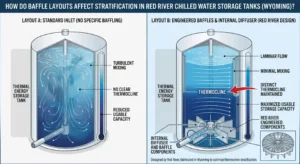
During the charge cycle, chilled water produced by the chillers, typically at a supply temperature between 35 and 44 degrees Fahrenheit, enters the storage tank and displaces the warmer return water. In a stratified tank, which is the most common configuration for large chilled water systems, cold water settles at the bottom and warm water rises to the top. The thermocline, the temperature gradient layer between the cold and warm zones, moves upward as the tank charges and downward as it discharges.
During the discharge cycle, cold water is drawn from the bottom of the tank and delivered to the facility cooling distribution system. Warm return water enters the top of the tank, maintaining the stratified temperature profile until the cold storage volume is exhausted.
The quality of the thermocline determines how effectively the tank stores and delivers cooling capacity. A tank with poor internal diffuser design or inadequate insulation loses thermocline definition over time, reducing effective storage capacity without reducing tank volume. For a breakdown of how volume requirements are calculated, see how much volume is needed for chilled water storage.
Red River designs insulation provisions, including insulation support rings, vapor seal weld details, and nozzle extension lengths, into every thermal storage vessel fabrication scope. These details preserve thermocline quality and system performance over the vessel’s full service life. Red River’s fabrication capabilities cover internal diffuser configuration, insulation system design, and vapor barrier details on every thermal storage vessel built.
How Does Storage Shift Cooling Load: Utility Rate Impact
The financial case for cooling load shifting is directly tied to the utility rate structure the facility operates under. Two rate components that thermal storage addresses are energy charges and demand charges.
How does storage shift cooling load through energy charge reduction?
Shifting chiller operation to off-peak hours, when energy rates are lower, reduces the average cost per unit of cooling produced. In markets with significant time-of-use rate differentials, this energy arbitrage alone can justify a portion of the storage investment.
Demand charge reduction
Demand charges are assessed based on the highest power draw recorded during a billing period. Reducing peak demand by shifting chiller load to off-peak hours lowers the demand charge for the entire billing period, even if total energy consumption remains the same. For facilities with high connected chiller loads, demand charge reduction is frequently the dominant financial driver for thermal storage investment.
The U.S. Department of Energy provides guidance on thermal storage system economics that can support load shifting modeling. ASHRAE also publishes widely referenced standards on chilled water system design and thermal storage performance benchmarks. Facilities evaluating thermal storage should model both components against their actual utility tariff before finalizing storage volume and operating strategy.
Get the Vessel Specification Right Before the System Is Designed Around It
The storage vessel is not a commodity component in a chilled water load shifting system. Its volume, insulation system, internal diffuser configuration, and connection layout all affect how well the system performs and how long it performs at that level.
Red River fabricates the insulated storage vessels and modular skid packages that are the physical foundation of chilled water load shifting systems, built to ASME standards and delivered with full documentation for every project. Getting the vessel specification right requires understanding the operating strategy, the load profile, the utility rate structure, and the site conditions before fabrication scope is finalized.
Ready to Discuss Your Cooling Load Shifting Project?
If you are evaluating how does storage shift cooling load for your facility and want to confirm the vessel specification, operating strategy, and sizing approach before the RFQ goes out, Red River works through all three as part of the early design conversation. That means reviewing the utility tariff, confirming the storage volume and efficiency factors, coordinating diffuser design for stratification performance, and identifying insulation provisions that must be built into the fabrication scope.
Request a quote or call 1-307-257-5332 to discuss vessel specifications before the system design is locked around a vessel that has not been properly specified.
Frequently Asked Questions
1. Which storage medium works best?
Water is the correct choice for the vast majority of chilled water thermal storage applications. It has high specific heat capacity, is non-toxic, widely available, and compatible with standard carbon steel and stainless steel vessel materials. Phase-change materials offer higher energy density in less volume but add system complexity and cost that is only justified when space constraints make a water-based system impractical.
2. When should storage be combined with free cooling?
When ambient temperatures drop below the required chilled water supply temperature, free cooling can charge the storage tank without running mechanical refrigeration. The combination is most valuable in climates with significant day-to-night temperature swings, including Rocky Mountain and high plains locations where overnight temperatures frequently enable free cooling even during summer.
3. What maintenance does a chilled water storage tank require?
A well-fabricated and properly insulated chilled water storage tank has minimal maintenance requirements. The primary ongoing needs are water chemistry monitoring and treatment to prevent internal corrosion in carbon steel systems, periodic inspection of insulation and vapor barrier integrity, and internal inspection at intervals appropriate to the vessel’s service conditions and applicable inspection standards.
4. How does ambient temperature affect storage system performance?
Cooler ambient temperatures improve chiller efficiency during the overnight charge cycle, reducing the energy cost of producing and storing chilled water. In Rocky Mountain and high plains climates, where overnight temperatures drop significantly even during summer months, the charge cycle efficiency advantage over daytime operation is often substantial.
5. Can a phased approach work for chilled water thermal storage capacity?
Yes. A correctly structured phased approach installs the first storage vessel sized for Phase 1 load shifting requirements, with civil infrastructure, piping headers, and connection points sized for the full intended system capacity from the start. Additional vessels are added in later phases as load grows or capital becomes available. Phase 1 infrastructure must be sized for full system capacity, not just the first vessel.
Key Takeaways
- Thermal storage shifts cooling load by separating chiller operation from peak demand, allowing chillers to run during off-peak hours and storing chilled water for delivery during peak rate periods.
- Full load shifting takes chillers completely offline during peak hours, maximizing demand charge savings but requiring larger storage volume. Partial load shifting reduces upfront capital at the cost of proportionally smaller savings.
- Stratified tank design preserves the thermocline between cold and warm water zones, which determines how effectively the tank stores and delivers cooling capacity over each charge and discharge cycle.
- Demand charge reduction is typically the dominant financial driver for thermal storage investment. Model both energy and demand charge components against the actual utility tariff before finalizing storage volume and operating strategy.
- The vessel specification must reflect the operating strategy, load profile, site conditions, and utility rate structure. A vessel not properly specified for the system it anchors degrades performance regardless of how well everything else is designed.
Related Blog Post
Can Condensate Storage Improve Reliability?
Where Do Condensate Tanks Fit in a Steam System?
Which Nozzles Simplify Maintenance on Pressure Vessels?
How to Vent Condensate Tanks in Steam Systems
How Do Baffle Layouts Affect Stratification in TES Tanks?
About Author