
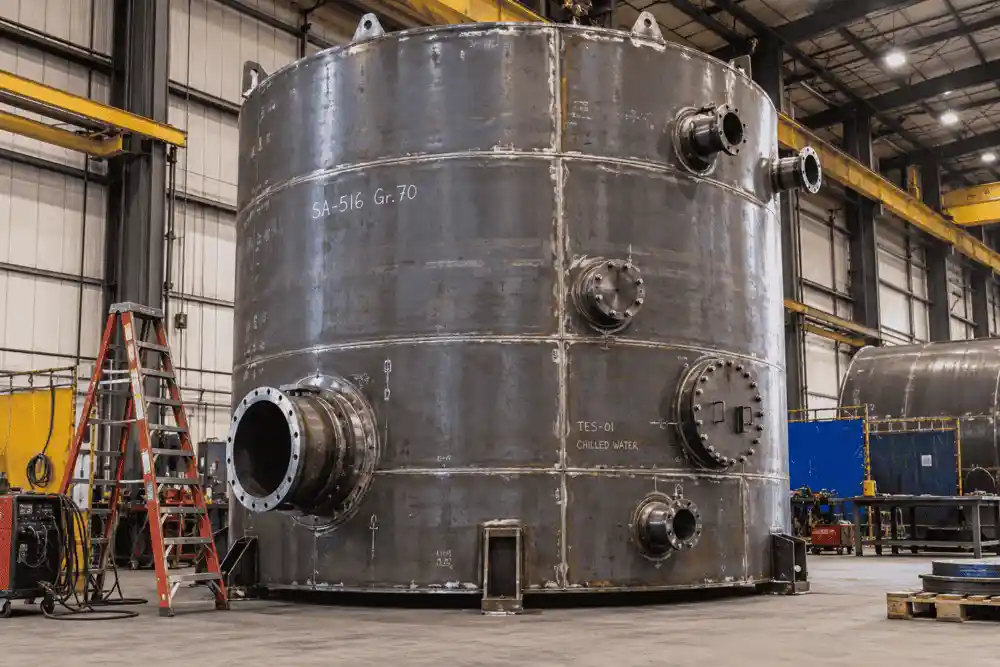
Industrial cooling energy storage stores refrigeration capacity generated during off-peak hours in an insulated, pressure-rated vessel and releases it during peak demand, reducing energy cost and peak electrical demand simultaneously. The storage medium is chilled water or a glycol-water mixture held in a fabricated ASME Section VIII pressure vessel sized to the facility’s cooling load, charge window, and delta T design.
Key Takeaways
- Industrial cooling energy storage stores chilled water or glycol at temperatures between 34°F and 45°F in an ASME-coded pressure vessel for deployment during peak cooling demand windows.
- Chilled water thermal storage tanks are sized from the facility’s peak cooling load, the charge and discharge window, and the design delta T across the storage system.
- Thermal stratification inside the tank separates cold supply water from warm return water. Internal diffusers and baffles maintain that separation and protect usable storage capacity.
- SA-516 Grade 70 carbon steel is the standard shell material for industrial chilled water TES vessels. Glycol service tanks may use stainless steel where fluid purity requirements apply.
- Every industrial cooling energy storage vessel operating above 15 psig must carry the ASME U Stamp under Section VIII, Division 1. Red River holds active ASME U Stamp and NBBI R Stamp certifications.
- Red River fabricates industrial cooling TES tanks from 500 gallons to 20,000 gallons, rated to 125 or 150 psig MAWP, with Type A and Type B internal baffles and four-inch through twelve-inch Class 150 RFSO nozzles.
What Is Industrial Cooling Energy Storage?
Industrial cooling energy storage is a load-shifting strategy that decouples the generation of chilled water from its consumption. A chiller or refrigeration system charges a large insulated storage vessel during off-peak hours, typically overnight when electricity rates are lower and ambient temperatures are cooler. During peak demand windows, the facility draws from that stored cold inventory instead of running the chiller at full capacity against peak rates.
Why Industrial Facilities Use Cooling Energy Storage
The economics are driven by the structure of industrial electricity tariffs. Most industrial facilities pay demand charges based on their peak consumption in a fifteen-minute or thirty-minute interval. A facility that shifts chiller operation to off-peak hours can dramatically reduce its measured peak demand and flatten its load profile. Peak demand reductions are widely documented in facilities that implement thermal energy storage as part of their cooling plant design.
Where Industrial Cooling Storage Is Applied
Industrial cooling energy storage appears in pharmaceutical manufacturing, food and beverage processing, chemical plants, campus chiller plants, and combined heat and power facilities, with fabrication capabilities that extend to data center chilled water storage. Each application has different cooling temperature requirements, delta T targets, and charge-discharge cycle profiles, which determine the vessel configuration, insulation standard, and internal flow distribution design.
How Does a Chilled Water Thermal Energy Storage Tank Work?
A chilled water thermal energy storage tank works by exploiting the natural density difference between cold and warm water. Cold water at 34°F to 45°F is denser than warm return water at 54°F to 65°F and stratifies to the bottom of the vessel. The warm return occupies the top. The boundary between the two layers is the thermocline.
The Role of the Thermocline
The thermocline is what makes chilled water TES thermodynamically efficient. A sharp thermocline preserves the temperature differential between supply and return, meaning the cold water drawn from the bottom is as cold as it was when it entered. A diffuse or disrupted thermocline allows warm and cold water to mix, reducing the effective storage capacity and lowering the supply temperature available to the cooling load.
Internal Diffusers and Baffle Design
The internal flow distribution system maintains the thermocline through charge and discharge cycles. Diffuser plates and baffles distribute incoming chilled water across the full horizontal cross-section of the tank at low velocity, preventing the jet mixing that would otherwise disrupt the thermal stratification. Red River fabricates TES vessels with Type A and Type B internal baffles designed to the specific operating flow rate, charge-discharge rate, and vessel geometry confirmed during the engineering review. See Red River’s thermal energy storage fabrication scope for how diffuser and baffle design is integrated into each vessel.
Charge and Discharge Cycles
During the charge cycle, cold supply water from the chiller enters at the bottom diffuser, displacing warm water upward to the return connection at the top. During the discharge cycle, cold water is drawn from the bottom and warm return water from the process enters at the top. The tank cycles between fully charged and fully discharged states over the course of each day without mixing the two layers.
How Is an Industrial Cooling TES Tank Sized?
Sizing a chilled water thermal energy storage tank requires calculating the ton-hours of cooling that must be stored to cover the peak demand period without running the chiller at peak load.
The Core Sizing Calculation
The required storage volume in gallons is calculated from the ton-hours to be stored, the design delta T across the storage system, and a stratification efficiency factor that accounts for thermocline mixing in practice. A stratification efficiency of 85 to 95 percent is achievable with correctly designed internal flow distribution. Poor diffuser design drops efficiency to 60 to 70 percent and requires a significantly larger vessel for the same usable storage capacity.
The simplified formula is:
V (gallons) = (Ton-Hours × 24) / (Delta T × Efficiency × 8.34)
Where Delta T is in °F and 8.34 is the weight of water in pounds per gallon.
Sizing Inputs From the Facility Load Profile
Key sizing inputs include the facility’s peak cooling load in tons, the duration of the peak demand window in hours, the off-peak chiller capacity available for charging, the chilled water supply and return temperatures, the required discharge flow rate, and the available footprint for the tank and insulation. Red River works through these inputs with clients before the fabrication scope is set, so the vessel is sized for the actual operating conditions it will face in industrial thermal storage service.
Standard Tank Sizes
Red River fabricates industrial cooling TES tanks from 500 gallons to 20,000 gallons as standard scope. Vessel diameter and height are selected to achieve the aspect ratio that supports stable stratification, typically a height-to-diameter ratio between 1:1 and 2:1. See Red River’s pressure vessel fabrication scope for how vessel geometry is selected against sizing inputs.
What Materials Are Used in Industrial Cooling TES Tanks?
Material selection for an industrial cooling energy storage vessel depends on the stored fluid, the operating pressure and temperature, and whether food-grade or pharmaceutical-grade fluid purity is required.
SA-516 Grade 70 Carbon Steel
SA-516 Grade 70 is the standard shell material for chilled water TES vessels in industrial service. It offers the combination of pressure vessel strength, weldability, and cost-effectiveness required for vessels operating at 125 or 150 psig MAWP at chilled water temperatures. All SA-516 Grade 70 plate used by Red River carries a certified mill test report (MTR) documenting chemistry and mechanical properties.
Stainless Steel for Glycol and High-Purity Service
Glycol-water storage tanks in pharmaceutical, food processing, or other high-purity applications are often fabricated in stainless steel to prevent metal contamination of the process fluid. The glycol concentration, inhibitor package, and operating temperature range are confirmed before material selection to ensure compatibility with fluid chemistry across the vessel service life.
Insulation and Jacketing
External insulation on an industrial cooling energy storage vessel is a critical performance component. Stand-off insulation systems using polyurethane foam or fiberglass with a protective jacket maintain the stored cold inventory between charge cycles. Insulation thickness is selected against ambient temperature, storage duration, and acceptable heat gain per day.
What ASME Standards Apply to Industrial Cooling TES Vessels?
Every industrial cooling energy storage vessel operating above 15 psig must be fabricated to ASME Boiler and Pressure Vessel Code Section VIII, Division 1, and must carry the U Stamp from a certified fabricator.
What ASME Section VIII Governs
ASME Section VIII governs the pressure vessel design calculation, material selection and traceability, weld joint classification and examination requirements, hydrostatic testing at 1.3 times the MAWP, nozzle reinforcement calculations, and the documentation package required for National Board registration. The Authorized Inspector witnesses the hydrostatic test and signs the ASME Form U-1 Manufacturer’s Data Report that travels with every coded vessel.
National Board Registration
Every ASME-stamped vessel is registered with the National Board of Boiler and Pressure Vessel Inspectors after fabrication. The National Board maintains permanent registration records that support in-service inspection under the National Board Inspection Code (NBIC) across the vessel’s full service life.
Red River’s Certification Scope
Red River holds active ASME U Stamp and NBBI R Stamp certifications. Every industrial cooling TES vessel leaves the Gillette, Wyoming facility with the ASME Form U-1, certified MTRs for all pressure-retaining materials, weld procedure qualification records, NDE examination reports coordinated through qualified inspection personnel, and the hydrostatic test record. See Red River’s capabilities for how documentation and certification are managed across TES vessel scopes.
How Does Industrial Cooling Energy Storage Compare to Ice Storage?
Industrial chilled water thermal energy storage and ice-based thermal storage are both load-shifting technologies, but they operate at different temperatures, require different equipment, and suit different application profiles.
Chilled Water TES
Chilled water TES stores energy at 34°F to 45°F, which is within the normal operating range of conventional centrifugal and screw chillers. No special low-temperature equipment is required. Chilled water TES is preferred for large industrial applications where the facility already has conventional chiller infrastructure and wants to add storage capacity without replacing equipment.
Ice Thermal Storage
Ice storage operates at 32°F and below, converting chilled water into ice during off-peak hours and melting it during peak demand. Ice stores roughly six times more cooling energy per unit volume than chilled water at the same temperature delta, allowing smaller storage volumes. However, ice storage requires chillers capable of producing water at 24°F to 28°F, which is below the operating range of standard industrial chillers and requires specialized equipment with higher energy consumption per ton of cooling produced.
Which Is Right for Industrial Applications?
Most large industrial facilities with existing chiller infrastructure use chilled water TES because it integrates without equipment replacement and achieves excellent efficiency at scale. Ice storage is more common in space-constrained commercial applications where volume is the primary design constraint. ASHRAE publications on thermal storage system design provide detailed guidance on selection criteria across different facility load profiles.
How Does Red River Approach Industrial Cooling TES Fabrication?
Red River approaches industrial cooling energy storage fabrication as a system integration challenge. The tank is one component in a feedwater and piping circuit that includes the chiller, distribution pumps, heat exchangers, and controls. Getting the vessel right means confirming the diffuser design, nozzle orientation, and connection sizing against the actual system layout before the first plate is cut.
Pre-Fabrication Engineering Review
Every TES tank fabrication project Red River executes begins with a pre-fabrication engineering review that confirms the design pressure and temperature, the internal baffle and diffuser configuration matched to the operating flow rate, the nozzle schedule and orientation relative to the installed piping system, and the material specification against the fluid and service conditions.
Modular Skid Integration
Many industrial cooling energy storage systems are delivered as complete modular skid packages that integrate the TES vessel with pumps, instrumentation, valves, and piping into a single pre-tested assembly. Modular delivery reduces field installation scope, compresses the commissioning schedule, and allows factory acceptance testing of the full assembly before it ships. See Red River’s prefabrication services for how modular TES scopes are managed.
What This Means When Specifying an Industrial Cooling TES Vessel
Industrial cooling energy storage vessels are only as effective as the stratification efficiency they achieve in service, and stratification efficiency is determined by the design decisions made before fabrication begins. A correctly sized vessel with poorly designed internal flow distribution achieves 60 to 70 percent stratification efficiency, wasting 30 to 40 percent of the nominal storage volume. A correctly sized vessel with engineered diffuser and baffle design achieves 85 to 95 percent.
The specification decisions, including aspect ratio, diffuser configuration, nozzle sizing and placement, shell material, and ASME documentation scope, all belong in the engineering review before fabrication begins.
Discuss Your Industrial Cooling Energy Storage Vessel With Red River
Red River fabricates ASME-certified industrial cooling energy storage vessels for pharmaceutical manufacturing, food and beverage processing, power generation, biogas, and industrial process cooling applications from Gillette, Wyoming, since 2003. Red River holds active ASME U Stamp and NBBI R Stamp certifications and is an American Welding Society (AWS) member. Standard TES tanks range from 500 to 20,000 gallons at 125 or 150 psig MAWP with SA-516 Grade 70 shell material and engineered internal flow distribution.
Ready to Specify Your TES Vessel?
Request a quote or call 1-307-257-5332 to discuss your cooling storage load, vessel sizing, and fabrication scope with Red River’s team. The specification review starts before any plate is cut.
Frequently Asked Questions
1. What Is Industrial Cooling Energy Storage?
Industrial cooling energy storage is a load-shifting strategy that stores refrigeration capacity generated during off-peak electricity hours in an insulated, pressure-rated vessel for use during peak demand. The storage medium is typically chilled water at 34°F to 45°F or a glycol-water mixture. The vessel is a fabricated pressure vessel built to ASME Section VIII that holds cold inventory until the process or facility cooling load requires it.
2. How Big Does an Industrial Cooling TES Tank Need to Be?
Tank size depends on the peak cooling load in tons, the duration of the peak demand window, the chilled water supply and return temperatures (delta T), and the achievable stratification efficiency. Red River fabricates standard TES vessels from 500 to 20,000 gallons and works through the sizing inputs with clients before the fabrication scope is defined.
3. What Is Thermal Stratification in a Chilled Water Storage Tank?
Thermal stratification is the natural separation of cold and warm water layers inside a chilled water TES tank based on the density difference between the two temperatures. Cold water is denser and occupies the bottom. Warm return water occupies the top. The boundary between the layers is the thermocline. A sharp, stable thermocline means the cold water drawn from the vessel is at its full design temperature. Internal diffusers and baffles protect the thermocline from jet mixing during charge and discharge cycles.
4. Does a Chilled Water TES Tank Need to Be ASME-Coded?
Yes. Any industrial cooling energy storage vessel operating above 15 psig must be fabricated to ASME BPVC Section VIII by a U Stamp-certified fabricator and must be registered with the National Board of Boiler and Pressure Vessel Inspectors. Operating a non-coded pressure vessel in this service violates code requirements and affects insurance coverage and jurisdictional registration.
5. What Is the Difference Between Chilled Water and Ice Thermal Storage?
Chilled water TES stores cooling energy at 34°F to 45°F in a large pressure vessel using conventional chiller temperatures. Ice storage converts water to ice at 32°F and below, storing roughly six times more energy per unit volume but requiring specialized low-temperature chillers that consume more energy per ton. Chilled water TES is preferred for large industrial facilities with existing centrifugal or screw chiller infrastructure. Ice storage is more common in space-constrained commercial applications.
6. How Does Red River Design the Internal Diffusers for a TES Tank?
Red River confirms the diffuser and baffle configuration against the operating flow rate, the charge and discharge rate, and the vessel geometry during the pre-fabrication engineering review. Type A and Type B internal baffles are selected and positioned to distribute incoming flow across the full vessel cross-section at low velocity, maintaining a sharp thermocline through each charge and discharge cycle. The diffuser configuration is shown on the fabrication drawing and reviewed by the ASME Authorized Inspector before production begins.
Related Blog Post
How to Vent Condensate Tanks in Steam Systems
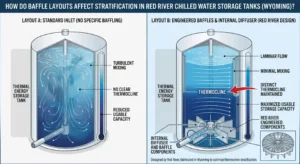
How Do Baffle Layouts Affect Stratification in TES Tanks?
What Delta T Drives Volume in Thermal Storage Tanks?
Carbon Steel Tanks: The Complete Fabrication Guide
Can Condensate Storage Improve Reliability?
About Author



