
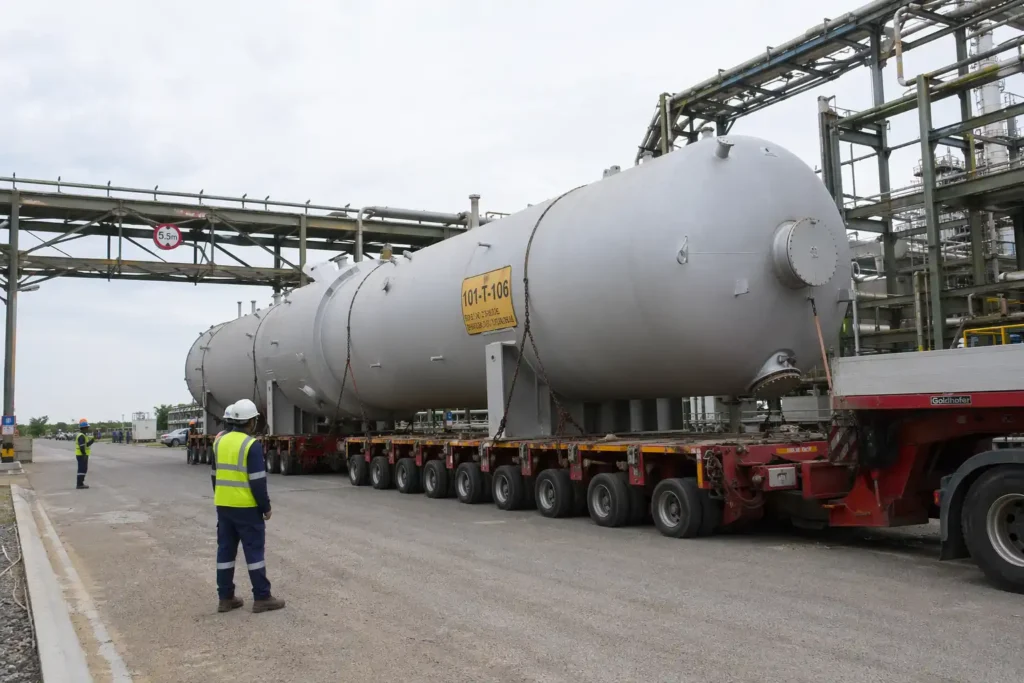
Site limits affect large tanks in ways that are almost always discovered too late. This guide is for project engineers and procurement managers working through large vessel specifications, covering the most common site constraints before fabrication scope is finalized.
Why Site Conditions Must Be Part of Fabrication Planning
Most of the decisions made during fabrication vessel orientation, nozzle placement, overall dimensions, and lifting configurations are either confirmed or constrained by the site the tank is going into. A horizontal vessel that cannot be rotated to vertical on arrival because of overhead crane limitations. A tank that fits the foundation but cannot clear the access road. These are not fabrication problems. They are planning problems that show up as fabrication consequences.
The time to surface site limits is during the engineering and design phase, before a single plate is cut. A fabricator who understands your site constraints can design around them. One who finds out at delivery cannot. Red River works through site condition reviews with clients as part of early project planning on every pressure vessel and modular skid project. The information gathered at that stage directly shapes how a vessel is designed, oriented, and configured for transport and installation.
The Site Limits That Affect Large Tanks Most Often
How Site Limits Affect Large Tanks: Access Road and Transport Route Restrictions
The most immediate constraint on any large vessel delivery is the transport route from the fabrication facility to the installation site. Oversized loads, which typically means anything exceeding 8.5 feet wide, 13.5 feet tall, or 53 feet long in most U.S. states, require special permits, route surveys, and in many cases pilot car escorts and law enforcement coordination.
Beyond the permit process, the physical reality of the route matters. Bridge weight ratings, overhead utility clearances, road width through rural or industrial areas, and turning radius limitations at the site entrance can all set a hard ceiling on what dimensions a vessel can have and still arrive intact. The Federal Highway Administration publishes guidelines on oversized and overweight loads that form the federal framework state permit requirements are built from.
For remote Wyoming and Rocky Mountain project sites, these constraints are particularly common. Sites accessed via county roads, lease roads, or mountain passes frequently impose tighter dimensions and weight limits than interstate standards. Identifying these limits before fabrication begins allows the design to account for them rather than fight them at delivery.
Foundation and Bearing Capacity
A large tank places significant point loads on its foundation through saddle supports on a horizontal vessel or leg and skirt supports on a vertical one. The foundation must be designed to carry those loads without settlement or failure.
What is less obvious is that the foundation design also constrains where on the vessel the load transfer points can be located. If the foundation is already poured, the saddle spacing or support leg placement must match it. If the foundation is still being designed, the vessel geometry should inform the foundation layout rather than the other way around.
Soil bearing capacity at the site determines what foundation type is feasible. This is one of the ways site limits affect large tanks that gets underestimated until a geotechnical report comes back with unexpected results. Rocky Mountain and high plains sites frequently have variable subsurface conditions that require geotechnical investigation before foundation design can be finalized. Red River’s fabrication capabilities include working through site-specific inputs during the design phase so support configurations are engineered for actual ground conditions, not assumed ones.
Overhead Crane and Lifting Equipment Capacity
Installing a large vessel typically requires either a crane or a specialized lifting and positioning system. The capacity, boom reach, and radius limitations of available lifting equipment at the site set a hard limit on how much a vessel can weigh and how it can be rigged.
For sites with permanent overhead cranes, the crane’s rated capacity and hook height determine what can be lifted and to what elevation. For sites using mobile cranes, the crane’s lift chart at the required radius is the governing constraint. Both of these need to be known before a vessel’s final weight and center of gravity are confirmed.
Modular skid packages are often sized and configured specifically around available lifting capacity at the installation site. Breaking a larger system into liftable modules that can be connected in the field is a direct response to crane and rigging constraints that would otherwise prevent single-piece installation.
Structural Clearances and Interference With Existing Equipment
Many large tank installations are additions to existing facilities where structural steel, piping headers, electrical conduit, and operating equipment already occupy space. The vessel envelope, including all nozzle connections, insulation allowances, maintenance access requirements, and operating clearances, must fit within what is actually available.
This is where accurate as-built drawings become essential. Designing a vessel to nominal dimensions and assuming it will fit into a congested existing facility is a risk that experienced project teams avoid. Interference checks before fabrication prevent conflicts that would otherwise require expensive field modifications or, worse, require a vessel to be modified after completion. Red River’s prefabrication services are built in part around the reality that many sites have constraints that make field assembly impractical or impossible without advance coordination.
How Site Limits Affect Large Tanks: Capturing Constraints Before Fabrication
The most effective approach is a structured site conditions review conducted before the fabrication scope is finalized. This review should capture transport route dimensions and weight limits, site access road conditions, foundation type and support point layout, available lifting equipment and rated capacity, overhead and lateral clearances in the installation area, and any existing equipment or structural interference.
This information feeds directly into the fabrication design. Site limits affect large tanks through vessel orientation, overall dimensions, nozzle layout, support configuration, and shipping split points all decisions that must be made with site constraints in hand, not discovered after fabrication is underway. Red River incorporates site condition inputs into the design review process for all custom pressure vessel and skid fabrication projects. Clients who bring site data early get designs engineered for their actual installation environment.
For related guidance on how site limits affect large tanks in chilled water storage applications specifically, see what is a chilled water storage tank and how much volume is needed for chilled water storage.
Talk to Your Fabricator About Site Conditions Early
Site limits do not have to create project problems. They create project problems when discovered late. A fabricator who understands your site constraints from the start can design around them, specify the right transport configuration, and coordinate the lifting and installation plan before anything is built. Whether the project is a single vessel or a full prefabricated system, the earlier that conversation happens, the more options remain open.
Ready to Work Through Your Site Conditions?
Site limits affect large tanks most when they surface after fabrication is underway. If you are specifying a large vessel or skid package and have not yet run a site conditions review, Red River can work through transport route constraints, foundation requirements, crane capacity, and clearance checks as part of the early design conversation. Getting site data into the fabrication scope before drawings are finalized is the difference between a vessel that installs cleanly and one that creates expensive field problems.
Request a quote or call 1-307-257-5332 to discuss what your site conditions mean for your fabrication design with Red River’s team.
Frequently Asked Questions
1. How do large-scale tanks balance peak demand?
Large-scale tanks charge during off-peak hours when chiller energy costs are lowest, then discharge stored chilled water during peak demand windows. At sufficient storage volume, the chiller plant can be taken fully offline during peak hours, flattening the facility demand curve without any reduction in cooling output.
2. Can a phased capacity approach reduce capital cost?
Yes. A phased approach designs the foundation, piping headers, and structural infrastructure for the full intended system capacity, then installs only the first vessel or vessels in Phase 1. Additional tanks are added in later phases as load grows or capital becomes available. The upfront cost of oversizing the civil and piping infrastructure is almost always less than retrofitting it later.
3. What happens if site constraints are discovered after fabrication is complete?
Options at that point are limited and expensive. Depending on the constraint, the vessel may need to be modified, re-routed through an alternative access path, or in some cases reduced in size by cutting and re-welding a completed vessel. Early site condition review exists specifically to prevent this scenario.
4. How does soil bearing capacity affect large tank installation?
Soil bearing capacity determines what foundation type is required to support the vessel’s operating weight without settlement or failure. Poor bearing capacity may require deep foundations, pile systems, or ground improvement, all of which affect cost and schedule. The vessel’s support configuration must align with the foundation design that the soil conditions make feasible.
5. Does Red River coordinate transport and installation planning?
Yes. Transport configuration, rigging plans, and installation coordination are part of the project planning conversation for large vessel and skid package projects. Red River works with clients to confirm that what is fabricated in the shop can be delivered and installed at the site without conflicts.
Key Takeaways
- Transport route dimensions and weight limits are often the first constraint that determines maximum vessel size. Confirm these before finalizing fabrication scope.
- Foundation design and vessel support configuration must align. If the foundation is already built, the vessel support points must match it exactly.
- Available lifting equipment capacity at the site sets a hard ceiling on installed vessel weight. Confirm crane ratings and rigging configurations before fabrication design is locked.
- Existing equipment, structural steel, and overhead clearances in the installation area must be checked against the vessel envelope including nozzles, insulation, and maintenance access.
- Site condition reviews should happen during the engineering and design phase, not after fabrication is complete. Modular designs and field-erected configurations are practical responses to site limits that prevent single-piece vessel installation.
Related Blog Post
Can Condensate Storage Improve Reliability?
Where Do Condensate Tanks Fit in a Steam System?
Which Nozzles Simplify Maintenance on Pressure Vessels?
How to Vent Condensate Tanks in Steam Systems
How Do Baffle Layouts Affect Stratification in TES Tanks?
About Author



