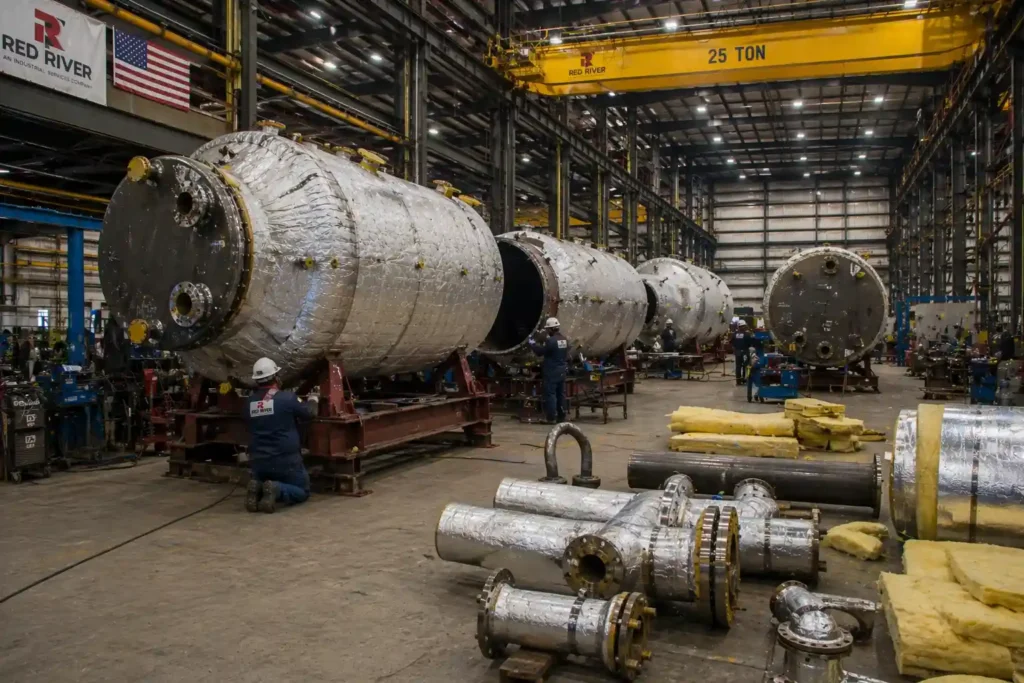
Choosing the wrong thermal storage medium creates problems that persist for the life of the installation. This guide is for procurement managers and engineers specifying TES vessels, covering which storage medium works best for each application.
Why Storage Medium Selection Affects More Than Just the Tank
The storage medium determines the vessel material, insulation system requirements, operating pressure and temperature range, the applicable fabrication code, and in some cases the entire system architecture. A specification decision that looks like a simple material choice at the front end of a project touches nearly every downstream engineering and fabrication decision that follows.
Procurement teams and project engineers who treat storage medium selection as a detail to be resolved later typically find the downstream consequences arrive during fabrication review or vessel specification, rather than during system design where they are cheapest to address. Red River works through storage medium selection as part of the early design review on all thermal storage vessel and modular skid fabrication projects.
Water: The Default Choice for Most Applications
Which storage medium works best for chilled water systems?
Water is the correct storage medium for the vast majority of chilled water, hot water, and low-pressure steam condensate thermal storage applications. It has a specific heat capacity of approximately one British thermal unit per pound per degree Fahrenheit, is non-toxic, widely available, and chemically compatible with standard carbon steel and stainless steel vessel materials.
The fabrication implications of water as a storage medium are straightforward. Carbon steel vessels, typically fabricated to ASME Section VIII using ASTM A516 Grade 70 plate, are appropriate for closed-loop systems with properly maintained corrosion inhibitor chemistry. Stainless steel, typically Type 304 or 316L, is used where water chemistry, chloride exposure, or system cleanliness requirements make carbon steel unsuitable. For a full breakdown of which grades apply in chilled water service, see which materials suit chilled water service.
Water-based thermal storage covers the full range from small buffer tanks in commercial HVAC applications to very large stratified chilled water tanks serving district cooling systems. ASHRAE publishes widely referenced standards on chilled water system design and thermal storage performance that cover water-based storage in depth.
The primary limitation of water as a storage medium is energy density. The amount of cooling or heating energy that can be stored in a given volume is fixed by its specific heat capacity and the allowable temperature differential between the charged and discharged states. When space constraints limit available tank volume, water-based storage may not provide the required capacity within the available footprint.
Phase-Change Materials: Higher Density at Higher Cost and Complexity
Phase-change materials (PCMs) store energy through the latent heat of melting and solidification rather than through sensible temperature change. At the phase transition temperature, a PCM absorbs or releases a significantly larger amount of energy per unit mass than water does through sensible heating or cooling across the same temperature range.
The most common PCM in commercial chilled water applications is ice, which stores approximately 144 British thermal units per pound during melting compared to approximately one British thermal unit per pound per degree Fahrenheit for sensible water storage across a ten-degree differential. Ice storage systems require chillers capable of producing water at temperatures below freezing, typically around 24 to 28 degrees Fahrenheit, which reduces chiller efficiency compared to standard chilled water temperatures.
The fabrication requirements for PCM-based systems are more demanding than for water-based systems. The heat exchanger surfaces that allow the PCM to charge and discharge must be designed for the specific thermal properties of the material. Containment materials must be compatible with the PCM chemistry, which varies significantly across material types. System complexity, maintenance requirements, and upfront capital cost are all higher than for equivalent water-based storage. The U.S. Department of Energy provides reference data on PCM thermal properties and application guidance that supports the selection decision.
PCM storage earns its cost premium when space constraints genuinely prevent a water-based system from meeting required capacity. For most facilities asking which storage medium works best, a properly designed water-based system remains the stronger answer when footprint is not a binding constraint.
Molten Salt: High-Temperature Industrial Applications Only
Molten salt thermal storage is used in concentrated solar power plants and high-temperature industrial process heat applications where operating temperatures range from approximately 290 to 565 degrees Celsius. At these temperatures, water-based storage is not viable, and molten salt provides a stable, high-energy-density medium that can store and release heat effectively across the operating range.
The fabrication requirements for molten salt storage vessels are substantially more demanding than for water or PCM systems. Material selection must account for the corrosive nature of molten salt at high temperatures, which eliminates standard carbon steel and requires specialty alloys. For the industrial and commercial applications that Red River serves, including oil and gas, power generation, biogas, and commercial chilled water systems, molten salt storage is outside the relevant operating range.
How to Match Which Storage Medium Works Best to Your Application
For chilled water systems operating between 35 and 55 degrees Fahrenheit: Water is the correct medium. The vessel specification follows from water chemistry, system type, and applicable code. Red River’s pressure vessel fabrication capability covers the full range of carbon steel and stainless steel vessel construction for water-based thermal storage.
For applications where space constraints limit available tank volume: Ice or another PCM at the appropriate phase transition temperature is worth evaluating. The evaluation should include a full cost and complexity comparison against a water-based system, including chiller efficiency impacts, heat exchanger fabrication costs, and long-term maintenance requirements.
For process applications involving thermal buffering in oil and gas, biogas, or power generation: The storage medium is typically determined by the process fluid itself. Red River’s prefabrication services cover these applications where vessel design is driven by process requirements rather than a standalone thermal storage specification.
For more on how storage medium selection connects to cooling load shifting strategy, see how does storage shift cooling load and can TES tanks reduce energy costs.
Confirm the Medium Before the Vessel Is Specified
Storage medium selection affects vessel material, fabrication code, insulation system, and system architecture. Understanding which storage medium works best for your specific application before fabrication scope is finalized gives your fabricator the information needed to design a vessel that performs over its full service life. Red River’s fabrication capabilities include storage medium review as part of the early design conversation on every thermal storage project.
Ready to Confirm the Right Storage Medium for Your Project?
If you are working through which storage medium works best for a chilled water, hot water, or process thermal storage application, Red River works through the selection before the vessel specification is locked in. That means reviewing the operating temperature range, available footprint, water chemistry, system type, and applicable code to confirm the right material before any fabrication decisions are made.
Getting storage medium selection right at the specification stage eliminates downstream fabrication complications, insulation system mismatches, and code compliance issues that are far more expensive to resolve after the vessel is built.
Request a quote or call 1-307-257-5332 to discuss storage medium selection before the vessel specification is locked in.
Frequently Asked Questions
1. How does storage shift cooling load?
Chillers run overnight during off-peak hours to generate and store chilled water. During peak demand hours, the facility draws from that stored capacity instead of running chillers at full load. In a fully load-shifted system, chillers can be taken offline entirely during the most expensive rate periods, reducing peak demand charges without reducing cooling output.
2. When should storage be combined with free cooling?
When ambient temperatures drop below the required chilled water supply temperature, free cooling can charge the storage tank without running mechanical refrigeration. The combination is most valuable in climates with significant day-to-night temperature swings, including Rocky Mountain and high plains locations where overnight temperatures frequently enable free cooling even during summer.
3. How does the storage medium affect the insulation system specification?
The storage medium determines the operating temperature of the vessel surface, which determines the magnitude of the thermal gradient between the vessel and the ambient environment, which determines the insulation thickness and vapor barrier requirements. A chilled water vessel operating at 40 degrees Fahrenheit requires a different insulation and vapor barrier specification than a hot water vessel operating at 180 degrees Fahrenheit, even if both are fabricated to the same pressure code.
4. What water chemistry parameters matter most for compatibility with carbon steel?
The key parameters for carbon steel compatibility in a closed-loop chilled water system are dissolved oxygen content, pH, chloride concentration, and the presence and concentration of corrosion inhibitors. Dissolved oxygen is the primary driver of internal corrosion in carbon steel systems. pH should be maintained in the range of approximately 7.5 to 9.5 for most carbon steel chilled water systems.
5. Does Red River fabricate vessels for both water-based and PCM thermal storage systems?
Yes. Red River fabricates pressure vessels and thermal storage systems for water-based and ice storage applications under the active ASME U Stamp certification. Fabrication capabilities cover the vessel, insulation provisions, and associated piping and structural scope for both standard chilled water storage and more specialized thermal storage configurations.
Key Takeaways
- Water is the correct storage medium for the vast majority of chilled water, hot water, and low-pressure thermal storage applications. Cost-effective, compatible with standard fabrication materials, and well understood across industrial and commercial applications.
- Phase-change materials offer higher energy density per unit volume than water but add system complexity, higher upfront cost, and reduced chiller efficiency in ice storage applications. Justified only when space constraints genuinely prevent a water-based system from meeting required capacity.
- Molten salt storage applies to concentrated solar and high-temperature industrial process heat applications above the practical operating range of water. Not relevant to most chilled water, hot water, or low-pressure process applications.
- Storage medium selection determines vessel material, insulation system requirements, operating pressure and temperature range, and applicable fabrication code. It is not a detail to be resolved after the system is designed.
- The selection decision follows from operating temperature range, available footprint, system type, water chemistry, and applicable specifications. Confirming these inputs before finalizing the medium protects every downstream engineering and fabrication decision.
Related Blog Post
Can Condensate Storage Improve Reliability?
Where Do Condensate Tanks Fit in a Steam System?
Which Nozzles Simplify Maintenance on Pressure Vessels?
How to Vent Condensate Tanks in Steam Systems
How Do Baffle Layouts Affect Stratification in TES Tanks?
About Author